
Some vintage accessories go extinct because they were impractical. Dress clips are not one of them.
They’re small, portable, and surprisingly clever — little bits of wearable engineering that can turn a plain neckline into something considered, secure a gaping wrap, or add sparkle to a coat or jacket. And yet… they’ve largely vanished from modern wardrobes.
Let’s give them a moment in the spotlight.
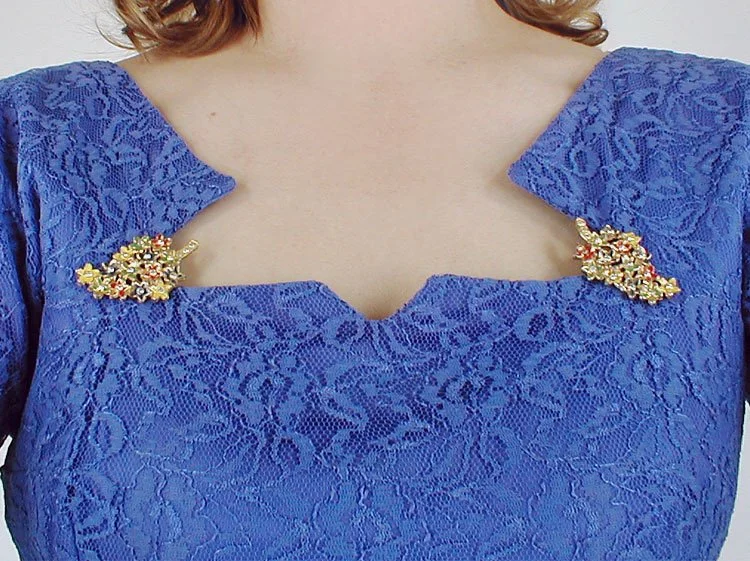
1930s enameled clips with rhinestones (denisebrain photo)
What is a dress clip?
A dress clip is a piece of jewelry that fastens with a spring clip rather than a pin stem. The finding usually includes a hinged, toothed paddle or plate designed to grip the edge of a garment — a neckline, strap, lapel, or fold of fabric.
That edge-gripping function is the key difference. Dress clips were made for places a traditional brooch pin can’t easily — or safely — go.
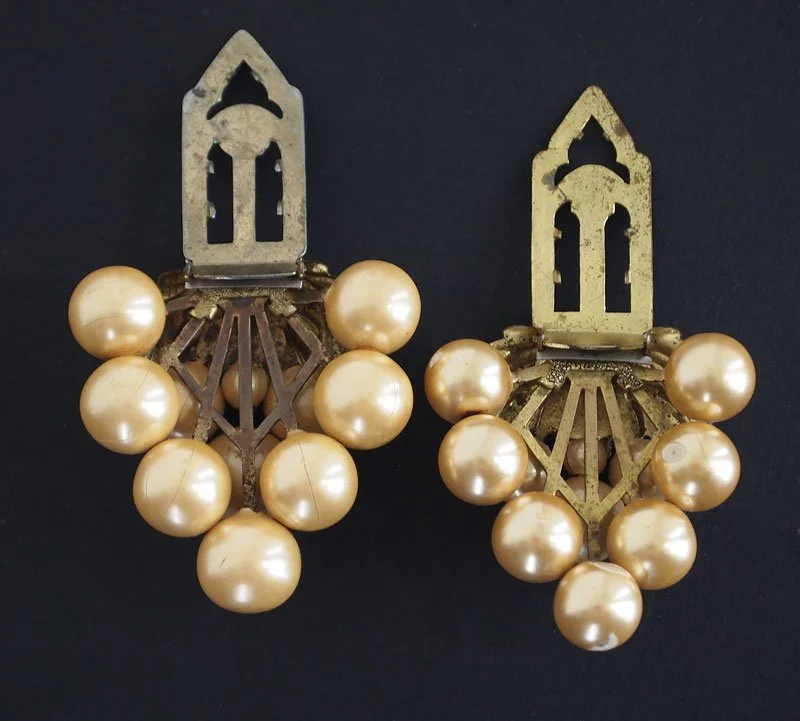
1930s pearlescent bead clips (denisebrain photo)
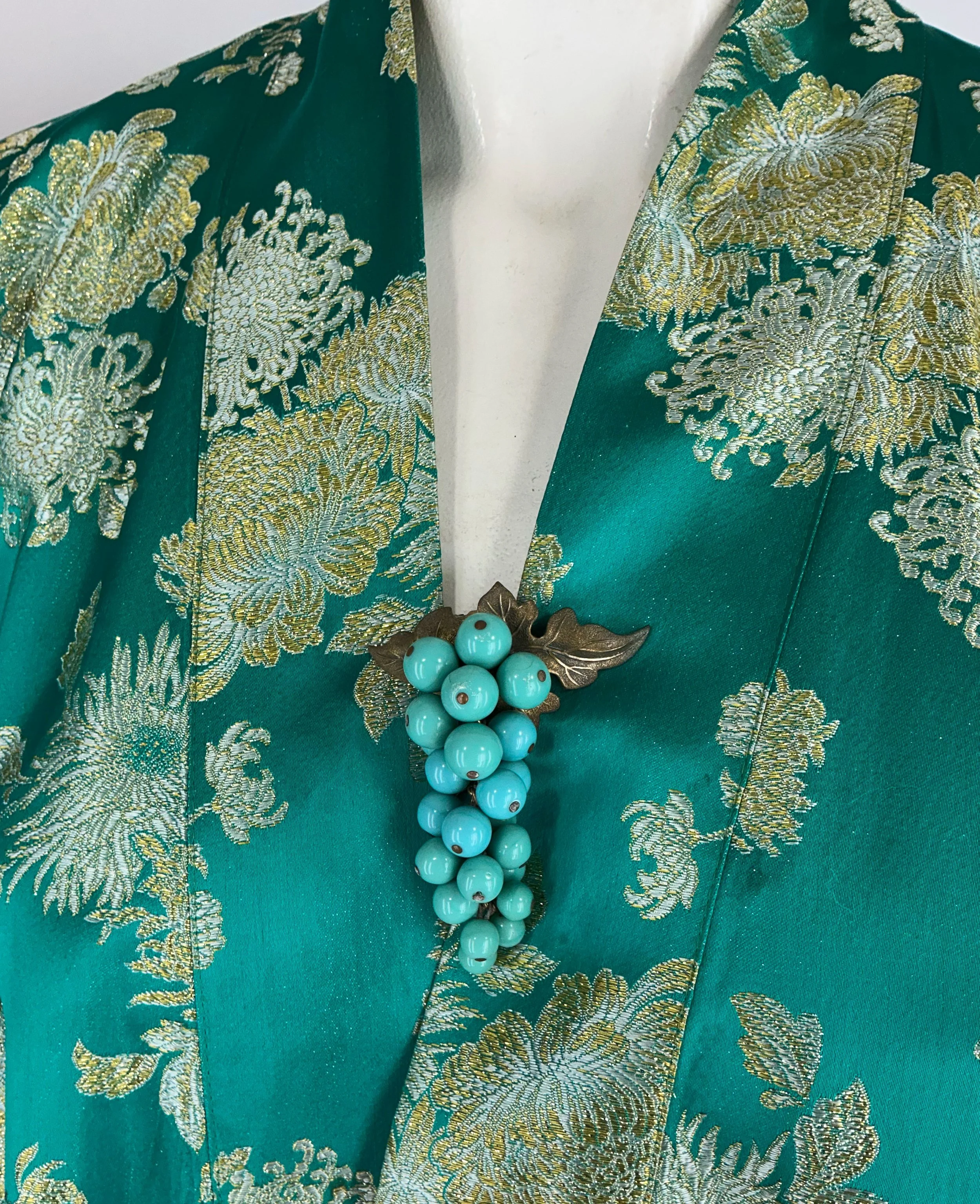
Although dress clips are often associated with matching pairs, period advertisements show they were sold both singly and in pairs. Some were designed for symmetrical placement, while others were intended as a single focal accent.
When were dress clips used?
Dress clips rose to prominence in the late 1920s and were at their peak of popularity in the first half of the 1930s. At a time when many women were making the most of garments already in their wardrobes, a small jeweled accent could refresh a dress, alter a neckline, or lend evening polish without the expense of a new frock. Period advertising emphasized novelty and Parisian flair, but practicality may have played a role in their popularity as well.
Clips stayed popular into the 1940s, showing up in both fine jewelry and costume jewelry. Then, as mid-century styling shifted and standard brooches returned to dominance, dress clips gradually slipped out of everyday use (many sources place that decline around the 1950s).
How were they worn?
If you’re used to thinking of a brooch as “left shoulder, end of story,” dress clips are more like useful little actors who can take various roles.
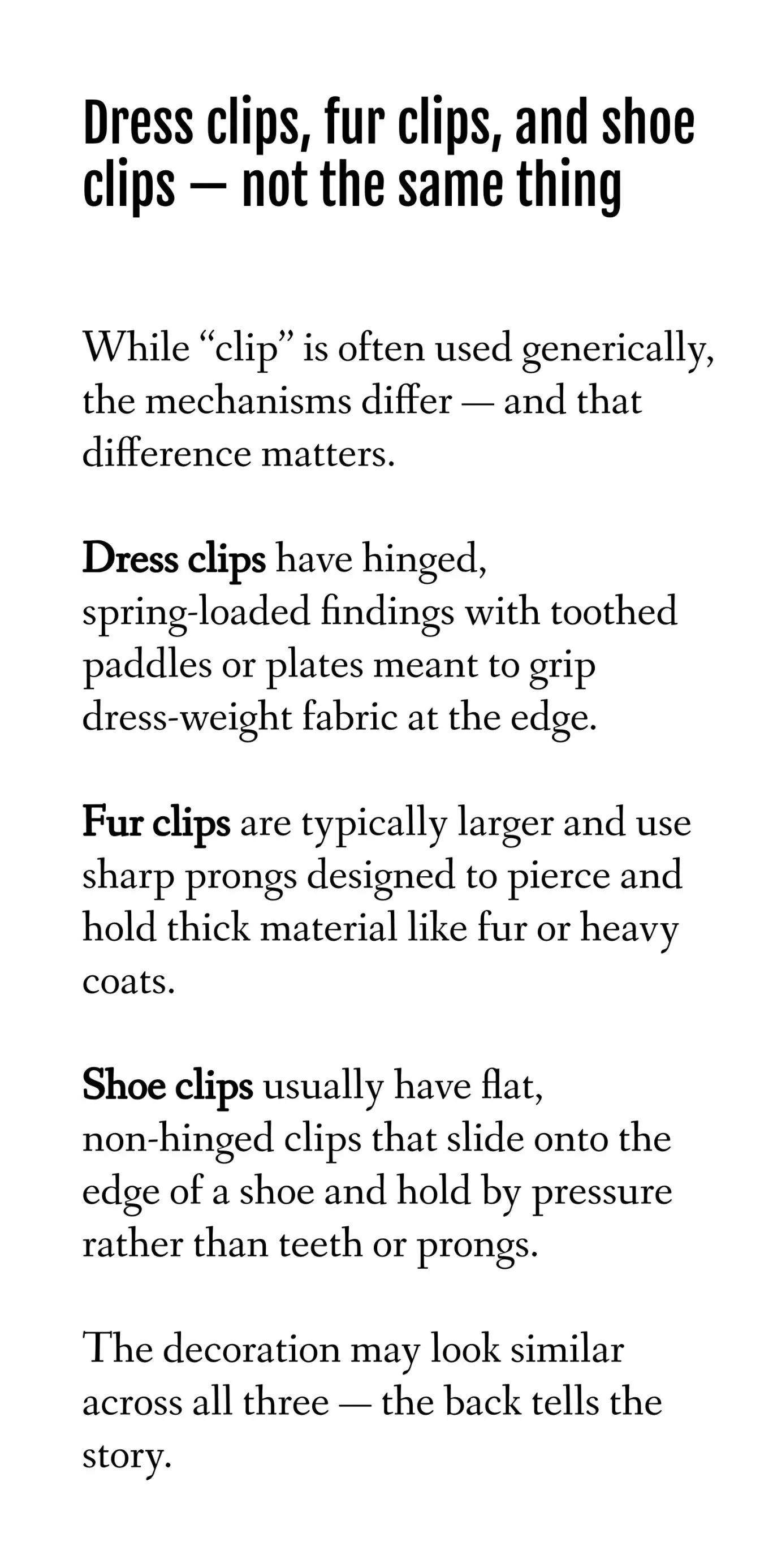
Period advertisements sometimes blurred the lines between dress, hat, bag, and shoe clips. The same jeweled ornament might be suggested for a shoulder strap, a handbag flap, or an evening pump. The message was clear: if it clipped, it could be styled.
Fashion writers also praised their practicality — clips were said to secure slip straps, fasten scarves, and even replace buckles on evening shoes, while being “the final syllable in chic.”
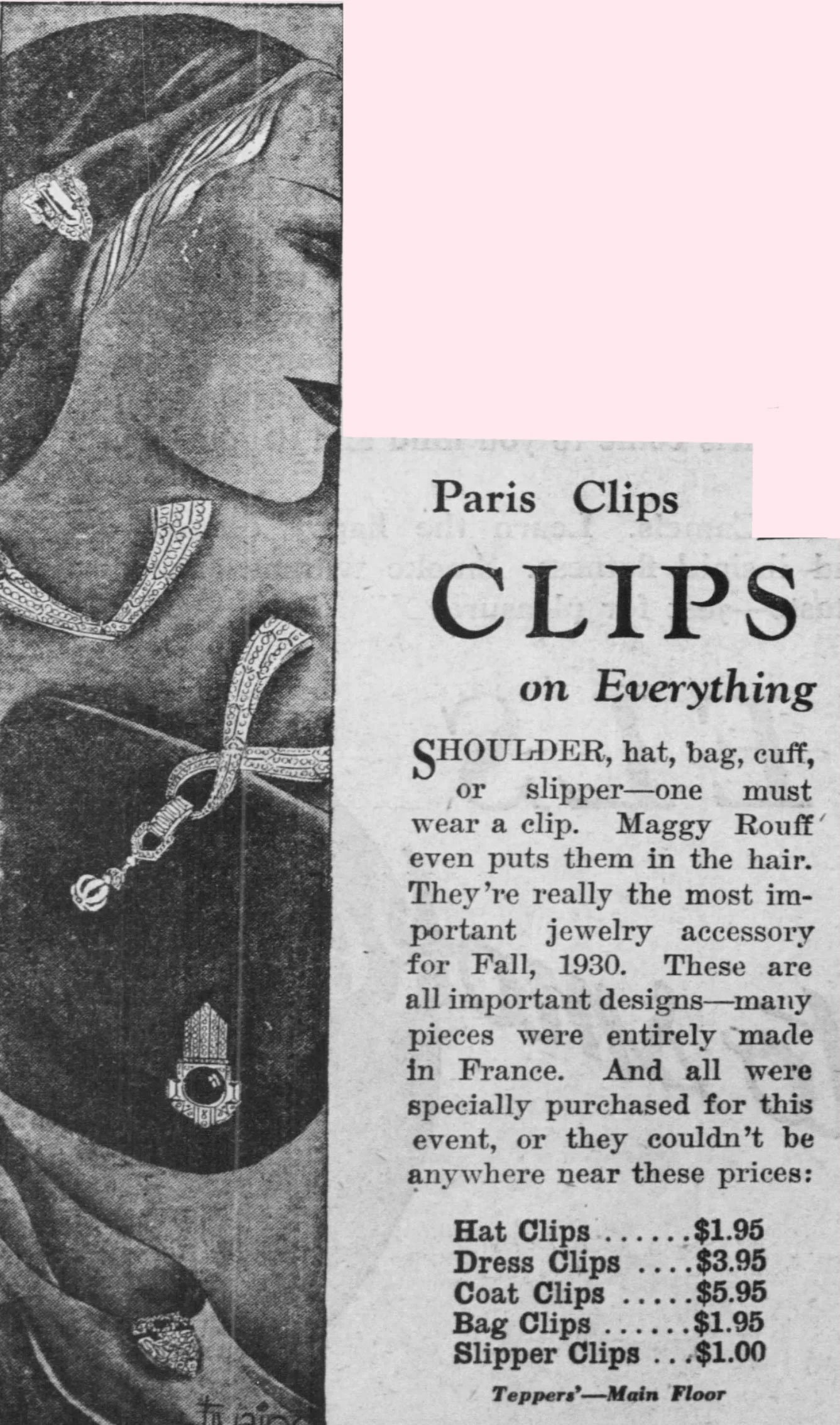
Department store advertisement, 1930. The Courier News (Tepper’s, Main Floor).
Period styling — and modern wear — includes:
Paired at each side of a neckline
Clipped to dress straps or shoulder seams
Centered at a V-neck or gathered bodice
At the back neckline — a little accent that’s especially lovely on gowns and party dresses
At the top of the shoulder — almost like a modern epaulet flair
On accessories — clipped to a bag strap or flap for instant personalization
On turbans and hats — a quick way to make headwear feel composed
As a pendant — slipped onto a ribbon or chain to become a necklace
At the center of a deep, low back neckline — a dramatic placement that feels very vintage eveningwear
On the side or the vamp of a shoe
They are especially at home on garments and accessories with edge definition or distinct focal points, which helps explain why they shine on everything from bias gowns to tailored coats to wrapped turbans.
In other words: they were made for clothes that had edges, folds, straps, and drape—and vintage fashion has plenty of those.
Materials and design
Dress clips appear in nearly every vintage jewelry language:
Art Deco rhinestone geometry
Molded and carved plastics
Fruit and floral motifs
Gilded metal and paste stones
Sculptural mid-century forms
Because they were often worn in pairs, designers frequently worked with mirror-image balance — something less common in standard brooch design.
Why did they fall out of favor?
Dress clips gradually fell out of regular use after the 1940s — not because fashion became simpler, but because garment construction changed. Earlier decades favored necklines, straps, and edges that invited clip-on ornament. By the 1950s, silhouettes became more structured, with finished facings and built-in trim — in other words, fewer “clip invitation zones,” even when the overall look was more elaborate.
But if you wear vintage (or even vintage-ish), dress clips are still wildly practical.
How to wear them now (without harming your clothes)
A few ways to reintroduce dress clips into modern outfits:
Use them where the fabric is sturdy: wool knits, heavier cottons, brocade, velvet, coating fabrics.
On delicate fabrics, give them a “buffer”: clip through a small ribbon tab, a facing, a seam allowance area, or a doubled fold rather than a single layer of silk.
Try them as a closure: a clip can gently persuade a wrap neckline, scarf, or cardigan edge to stay put.
Think in pairs: if you have matching clips, put them to work framing a neckline or sitting symmetrically on straps (very 1930s, very satisfying).
Think of them as portable focal points: centering a bow or tie, placed in a chignon, or sparkling on the edge of a cuff.
Dress clips may have slipped quietly out of fashion, but they were never obsolete. They were designed for clothes with edges, folds, and movement — and those clothes are still with us. If anything, they reward attention: to construction, to placement, to detail. Perhaps that is why they feel so satisfying now.
And yes—dress clips are also simply beautiful objects. Art Deco geometry, floral scrolls, rhinestone “constellations,” molded glass, Bakelite, enamel—there’s a whole design universe packed into two inches.
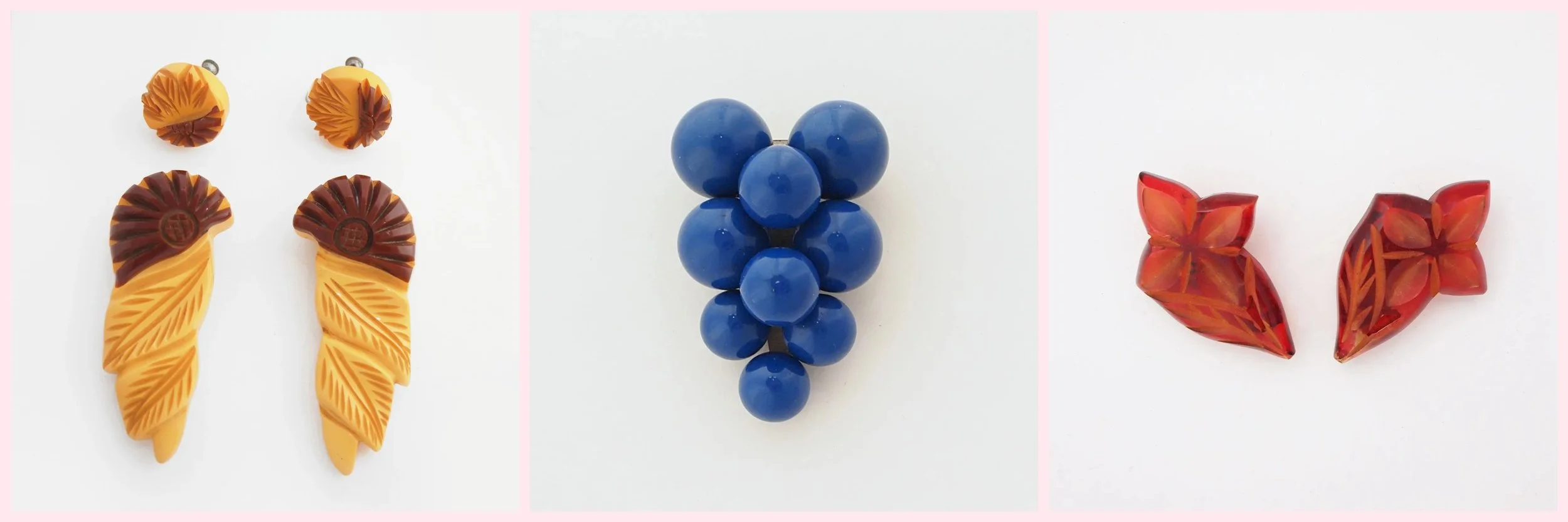
Several of the dress clips from my shop inventory, made of carved Bakelite and enameled wood.