Comment

So Thankful

Once again, we’re back around the sun to the day many people in the United States celebrate as Thanksgiving.

Whether you celebrate this day or not, gratitude is never wrong.

I am so thankful for my customers, my readers and my colleagues. Thank you so much for caring about vintage clothing and supporting one woman’s small business. Thank you.

It’s a great time of year to think about the impact of what you purchase and consider the joyful and optimistic choice of a vintage item.

Tomorrow is Black Friday, and I do indeed have a sale in my Etsy shop. I always want to make the distance between people and vintage fashion as small as I possibly can. I’ll be back with some great vintage picks soon.

But today, did I remember to say thank you? Thank you.

Comment

Comment

Vintage Fabric: Determining the fiber of a fabric

I am giving a once-a-week x possibly forever (!) vintage fabric workshop in the Vintage Fashion Guild public forum. If you’d like to join in, you’ll find the workshop under “Fabric Friday” HERE.

You can also follow along here in my blog, where I intend to post some of the same content. Please ask questions! I love questions.


If you’re a vintage fashion dealer, you probably know all about how challenging it can be to decide what fabric your item is made of. Maybe you’ve even given up on trying! However there are some very good reasons to figure this out.

  1. Customers often want to know. After all, some find wool irritating, some hate wearing polyester, some will spend more for silk, and so forth.

  2. The fabric can help gauge the value of an item for selling purposes.

  3. Knowing the fiber of the fabric can help date the item. For instance, nylon wasn’t available commercially on any real scale until after WWII, so a nylon nightgown most likely won’t date from prior to 1946.

  4. Knowing the fabric makes you a more trusted and helpful seller.

  5. You will have a better idea of how to clean an item.

If you are a vintage fashion buyer, you will have some of the same interests: How to clean, how much to pay and what you like to wear.


So I start this series with a bit about determining the fiber of a fabric.

This is just slightly adapted from the Determining Fiber page of the VFG Fabric Resource, which I wrote and compiled.


If you have a piece of vintage clothing without a fabric content label and you’d like to know what the material is made of, try the most accessible test out there: A fiber-burn test. The basic process involves snipping a small piece of fabric from an inseam, then carefully burning it with a lighter while observing how the fiber behaves (looks, smells, feels) during and after. You can then compare your findings to a chart.


There are a number of tests, some traditional but potentially inconclusive (such as dampening and creasing a fabric to see how it behaves) and some quite scientific but not accessible to the average person (exposing yarns to certain chemicals and examining them under a microscope). By far the most accessible test is burning.

Burning fibers takes practice, and you must start with a little caution. Tie long hair back out of the way. You should burn over a sink or bucket so you can allow the potentially molten fiber to drip safely, and drop your sample if necessary. You need a pair of tweezers to hold a small fabric swatch, and a lighter. If you burn matches of any sort you will pick up the scent of burning paper or wood, throwing you off for discerning the burning fabric’s odor.

If you are testing a finished garment, find an inconspicuous place to cut a small sample, usually a seam allowance. Even a few yarns are “readable” with experience, but a piece of about 1” × 1/4” is ideal. Hold one end of the fabric with the tweezers and slowly expose the other end to the flame of the lighter. Notice if the fabric readily burns or takes some effort to light. Also, note if the fire burns out or continues until all the fabric is burned. Smell the smoke as the fire goes out. Finally, when the sample is cool enough, feel the residue and note its color. Compare your findings to the standards in the burn chart, below.


Of course, many textiles are made of fiber blends. Pull apart warp and weft yarns and burn them separately, as the blend may be as simple as one distinct fiber in the warp, another in the weft. Another test is to untwist an individual yarn and burn the plies separately. In both these cases, try to bundle and twist together like threads so that you have a swatch of sufficient density to burn accurately. Other blends may seem inconclusive, but feature a “top note” that is discernible—such as the “burning feathers” odor of silk. Even knowing part of the fiber is helpful.

To train yourself about how a fiber burns, try taking clippings of known fabric samples and get used to each sample’s characteristics when burned.

You can find YouTube videos of fibers being burned, and that may help with the visual side of the process.

Several factors may effect how a fabric burns, including finishing treatments, density of the weave, and even the dye used.

Your senses also will help determine a fabric’s fiber content without burning, given a chance to learn. With experience, silk, wool, rayon, polyester, acetate—all fibers, are discernible just by look and feel. Spend time handling known fabrics; keep your own swatch book to compare. If you have a chance, be taught first hand: You may be fortunate to find a person who is knowledgeable about textiles and can guide you. Experience with a fabric mentor could make a complex project much easier and more memorable.


One technical test of fiber content available to the average person is microscopic examination, using a relatively inexpensive hobbyists’ or children’s microscope (just 100x magnification is plenty for this purpose). Photos of magnified textile fibers can be seen in books and online.

I don't own this, but I'm considering ordering this hand-held microscope: Carson MicroBrite Plus 60x-120x LED Lighted Zoom Pocket Microscope. (This is an Amazon affiliate link. That means if you click on the link and purchase the item, I will receive a commission at no extra cost to you.)

On another level, a technical evaluation of solubility uses hazardous chemicals to test fibers. Generally these tests are only run in laboratories. One test of this kind, though, is available to the average person—using acetone. (Look for pure acetone among nail polish removers.) At room temperature, acetate will dissolve in acetone (brush it on with a cotton swab). Triacetate will disintegrate. Modacrylic and vinyon will soften.


I know that a number of people struggle with the fiber burn test for various reasons. (Someone told me recently that it sets off the smoke detector in her apartment!) What can I do to help?

Comment

Comment

Vintage Fabrics Basics

Because experience with fabric really ranges among vintage fashion enthusiasts, I decided to start a series on some of fabrics you are likely to find.

I am posting a once-a-week x possibly forever (!) vintage fabric workshop in the Vintage Fashion Guild public forum. If you’d like to join in, you’ll find the workshop under “Fabric Friday” HERE.

You can also follow along here in my blog, where I intend to post some of the same content. Please ask questions! I love questions.


First let me tell you a little about my own history with fabric:

Some of my fabric books.

One summer, I read the Fairchild’s Dictionary of Textiles cover to cover (all 14,000 definitions—don't I know how to have fun?) and chose a collection of fabrics that seemed to come up in vintage clothing descriptions and in my observations. I didn’t, and don’t, consider myself an expert on the subject, but I love learning about fabrics.


I really have to know fabric better all the time. I sell vintage clothing, and my buyers and I want to know what an item is made from. To know this is to tell someone whether she will be allergic, how to wash or clean the item, predict how it will take dye. It is to know how fine it is, how long it will last, how the color will hold up. It helps make certain the age of the item. It gives a better sense of how it will feel when worn. Buying clothing online is hard enough, and knowing all you can about the item is just smart.


The year after I read the Fairchild’s I was a board member of the Vintage Fashion Guild, and I proposed the idea of the VFG website having a fabric resource. Everyone thought this was a good idea, so I got started on it. You gotta watch what you promise, because I worked five years putting just the start of the Fabric Resource together! Fabrics are complicated. As one article in an issue of the great American Fabrics magazine begins:

The history of textiles is the history of the world...politically, socially, economically.​

Gulp.

So much of human history has been interwoven with fabrics—any one fabric can take you back to ancient civilizations, or even prehistoric times. This makes many of them difficult to quickly summarize. I noted one of the fabrics in the Fairchild’s that was particularly mind-boggling for me, frisé.

frisé [free-zay’] 1. Originally the finest grade of linen made in Friesland, The Netherlands. It was strong, stout, grained, and well-bleached. 2. A French term for curled. 3. A coarse ratiné fabric that is made with slub yarns in a plain weave ( See RATINÉ 1.) 4. A looped pile fabric usually of uncut loops that may have a pattern cut into them. This term sometimes is used for TERRY CLOTH or BOUCLÉ FABRIC. 5. A coarse, stout cotton or linen fabric that is made in a plain weave with a flat, wiry texture and a pronounced rep or rib. Made in imitation of the worsted or mohair pile fabric known as FRIEZE. All fabrics listed in 1.—5. are used for upholstery. 6. A cut pile carpet of twisted yarns in solid color or of varicolored yarns.

You can see there are divergent histories here, along with terms that may not be familiar (they certainly weren’t all familiar to me). There are comments about usage, origins of the name, related fabrics. Not all fabrics have this much complexity in their definitions, but some have more.


I’m not trying to scare anyone off. On the contrary, I hope that knowing about fabric is interesting and inspiring to you as much as it is to me—or that it could be.


Starting with some basics

Before 1960, clothing rarely had any fabric content and care labeling. The Textile Products Identification Act of 1960 mandated fabric content labeling in garments. This information was usually printed on a hang tag that was removed before wearing the clothing. Our familiar sewn-in care tags were required starting in 1972. This was a huge step in making clothing easier to maintain. Now, we take these tags for granted, but our forebears had to know enough to make good washing and other care decisions themselves.


The fiber is from what the fabric is made, while the fabric is the finished product. Let me say that again, because it is really important:

The fiber is from what the fabric is made, while the fabric is the finished product.


Fibers can be natural: mainly cotton, wool, silk, and linen; or manufactured: mainly rayon, acetate, acrylic, nylon, and polyester.

The fibers can be woven or knit into fabric. The most common weaves are plain, satin and twill.

The anatomy of the basic weaves: plain, satin, and twill, along with knit​

Fabrics have a two-part name: One part is the fiber or fiber blend, the other is the fabric type. If you see a fabric listed as silk taffeta, you are being told that the fiber is silk, and the fabric type is taffeta. Likewise, a rayon jersey is a jersey knit fabric made of rayon fiber.

Next time: How to determine the fiber of a fabric

Comment

Tips for a beginning online vintage fashion seller

2 Comments

Tips for a beginning online vintage fashion seller

I was recently asked the question “what makes a good purchase for someone interested in selling vintage?” and the bigger question “what does it take to be a vintage fashion seller?”


Before I can answer, I need to ask the questioner: Are you interested in this as a hobbyist, or are you interested in having a business? There’s nothing wrong with either.

Only a tiny percentage of vintage fashion sellers get anywhere close to rich, so it is very important to have big dreams but realistic expectations. You may have heard that there is a huge and growing market for vintage clothing. That’s true, but there is also a huge and growing number of people selling it. I believe you need to have a passion for vintage fashion, however if you want to make it a successful business (not just a hobby or labor of love) you have to go further.

Vintage clothing is a wonderful thing, and if you want to work to provide it for others, I applaud you. Of course I feel that way because that is what I do—and I love what I do. It requires a lot of hard work, patience, knowledge, resources (time, money and information), creativity and passion. I figure you wouldn’t be reading this if you didn’t have a fondness for the idea of your own vintage business, or at least a curiosity about it. Loving vintage fashion is the simple part.

Tips on what to buy for resale

There are markets for diverse vintage items, and the second thing I’d recommend, after truly appreciating what you are offering, is to learn everything you can about your chosen area of vintage. Get to know labels, history and fabrics (the Vintage Fashion Guild’s Label Resource, Fabric Resource, and Fashion Timeline are great for this). Next, see what others in your chosen area are doing. Look at their shops and interact with them on social media. See what interests their customers. Don’t be discouraged if a vintage dealer seems to be untouchably popular. Be inspired, then differentiate yourself. I once heard “better isn’t better, different is better.”

When choosing items to purchase, be aware of your brand and marketplace, but understand you have to start somewhere. If you are just beginning to work with vintage, find items you would like to wear yourself, in great condition.* Look the item over before buying: test zippers, check for lost buttons, look for holes, fading, stains, seams that are open and hems that have come out. Don’t forget to smell the item, too. If you have mending and cleaning skills, then decide if you can tackle any flaws and how much time and effort it would take. If you aren’t skilled at fixing and cleaning, and the item isn’t truly fabulous, I’d put it back on the rack. Saving vintage is noble but not very cost effective, so if you’re in love with a damaged item and want to make it your mission to salvage it, consider it a hobby/labor of love item.

Once you become more familiar with the marketplace, you can expand what you offer in your niche, finding things you see are selling for others, as well as what your customers seem to like the best. Runway trends, movies and shows sometimes drive interest in certain eras and styles, so it helps to keep up with popular culture.

*For those interested in selling vintage denim, workwear and t-shirts, there are some different criteria—well-worn condition could be preferable.

It is a good business practice to purchase at a price that makes sense for resale. However, there are as many formulas for pricing as there are vintage sellers, some very specific, and some almost random. Here is an excerpt from a previous blog about how vintage fashion is priced.

What influences how vintage fashion is priced

✔️ Location. In some areas, there may be relatively more or less vintage available, and at more or less high prices. Just to sustain the business may take more income in some areas than others.

✔️ Scarcity. Vintage clothing and accessories that pre-date the 1980s are hard to find in many areas, and the older, the scarcer. One of the most rare things of all the 20th century seems to be a beaded silk dress from the mid 1920s in excellent condition. The amount of activity (think dancing the Charleston) that some of these dresses endured in their Roaring 20s heyday took a toll, and the combination of the delicate fabric and heavy decoration has made these dresses extremely ephemeral. With the popularity of 1920s styles over the past few years, many seek these dresses and are truly amazed at the prices—but what’s really amazing is that there is an authentic beaded silk dress from the 1920s left to sell!

Some other scarcity issues involve sizes (such as larger shoe and dress sizes) and types of items (generally trousers are more worn out and disposed of than skirts, menswear more than womenswear, swimsuits can take a beating, as can shoes...).

✔️ Condition. A 1950s dress can cost $49, $98 or $300 even in the same shop, with the $49 dress being pretty but flawed, the $98 a simple dress in excellent condition and the $300 dress pristine and with a good label and great design. Condition means so much in valuing vintage because it really affects the wearability, life expectancy of the garment, and acceptability for various occasions. Would you want to attend your friend’s wedding in a dress with an obvious and unremovable stain on the front? No, but you might wear the dress to a swing dance.

✔️ Quality. There is a reason vintage haute couture is haute priced: It is the work of a great designer, skillfully and beautifully crafted with techniques that are becoming rarer and rarer. The materials will match the workmanship and the overall impression will be, most likely, breathtaking.

Unlabeled items can also be of outstanding quality, and a good seller will take the trouble to explain the elements of an item’s quality. It is important to know that certain designers, labels, styles, eras, fabrics, and embellishments can justifiably command high prices. Even color influences price. Would you pay more for an aqua blue dress or a similar dress in brown?

✔️ The seller. If a seller has a great reputation, with excellent references and knowledge, he or she can charge more for an item. Some excellent sellers don’t charge at the top of the spectrum, but many do. They also will stand by their sales, something that is not easy to do with vintage, each item being unique. If you enjoy the offerings of particular sellers, and you know you can trust those sellers, their finds will probably be worth more to you.

✔️ The selling venue. Are you walking into a posh Manhattan vintage shop or an antique mall in a small town? Which do you think will need to charge more for that vintage handbag? Right.

✔️ Provenance. If Marilyn Monroe wore an item (such as the dress she wore singing Happy Birthday Mr. President, which sold at auction in 2016 for $4.8m), it is worth many times more than its weight in gold. Even if there is not a famous person tied to the vintage fashion item, a sweet or interesting story can push the value of the piece.

✔️ Going rates. Experienced vintage fashion sellers usually research before they price an item, working to find the right price for what they consider to be their place in the market, seeing how other sellers have priced. As I said before, shows and movies will drive interest in a style and the going rate will go up accordingly.

✔️ Work on the item. Some vintage items are ready to go as found, but usually they need washing or dry cleaning, often a bit of mending. In some cases, a large amount of work goes into preparing a vintage garment or accessory for use. Some items are definitely worth the time, like one of those rare 1920s beaded silk dresses—if they are damaged but reparable, the repairs are often worthwhile for bringing such a beautiful piece of history back to life. Of course, excellent work takes knowledge, skill and time.

✔️ Desirability. This is a catch-all that overlaps the quality, scarcity, selling venue, seller—everything. Sometimes there is a certain je ne sais quoi about how the item is presented that makes it—and the seller—hot stuff. The same item may be almost worthless in other hands.


When I started my online vintage clothing business in 1999, inspired by the 1970s and 80s brick-and-mortar vintage shops that I had frequented. I was new to the internet in the late 90s and as I became somewhat known in the world of vintage on this platform, I had requests for tips on selling and on running a vintage fashion business. The people asking were usually not casual here-and-there sellers, but people striving to earn at least a partial living at it. There weren’t so many of us then.

26 pieces of advice for a beginning vintage fashion seller
The kind of store I used to frequent: Chiz Blares in Chicago, with the owners Angela Peters and Nan Strain. Photo by Bob Fia for the Chicago Tribune, October 2, 1979.

The kind of store I used to frequent: Chiz Blares in Chicago, with the owners Angela Peters and Nan Strain. Photo by Bob Fia for the Chicago Tribune, October 2, 1979.

I used to have a fairly short—though not simple—list of suggestions. It went something like this:

1. Know everything you can about the items you are selling. Do not bluff if you don’t know something, but research labels, fabrics, fashion history and whatever else you need to write with some confidence and accuracy about items.

2. Provide detailed garment measurements.

3. Photograph and describe every more-than-miniscule flaw.

4. If you’re just starting, price accordingly. Carefully research the higher and lower ends and don’t expect to be a high-end seller if you are new to the field. Save your exceptional items for a time when you are more established.

5. Always be polite, clear and prompt in dealing with questions from customers and potential customers.

6. Ship as quickly as possible—within 48 hours is expected.

7. The customer is always right, even if they might not be. Always give them the benefit of the doubt and treat them with respect and kindness.

8. Don’t buy vintage items for resale because they are inexpensive, buy them because they are great.

A few years later I started adding in:

9. Don’t be lazy in the least. If there is something that you can do to help a garment you are selling, do it.

10. Become good at mending and washing/cleaning; find the best dry cleaner in your area, and also a skilled seamstress if you are not one yourself.

11. Generate enthusiasm for your items by writing helpful, interesting, and knowledgeable descriptions.

12. Find the best, most efficient selling methods and use those.

13. Strive to connect to buyers through social media, online and offline contacts.

14. Offer an explicit return policy, and detail all your shop policies clearly and politely.

15. Do not expect quick results. Be patient and build your brand.

Now there are millions of vintage clothing sellers all over the world, many of them doing an excellent job. What you need to do to stand out will, by necessity, be more involved. I would have to add the following to the above:

16. Use professional-quality branding (the quality of which is not always based on a price paid).

17. Develop a social media strategy and keep it up consistently.

18. Make sure your photos are detailed, beautiful, and accurate. If using a live model, be sure they are pro or very talented at portraying your brand. There are various ways to do lighting, but whatever your choice, it needs to be excellent.

19. Join and take part in appropriate forums for information about vintage fashion and the business and to discuss issues with colleagues.

20. Find strategic and memorable ways to differentiate your business in a crowded field.

21. Be extremely competitive in sourcing vintage items to offer for sale.

22. Do detailed market research and study analytics.

23. Find a good selling venue and be ready to jump to others if needed.

24. Do not assume a website will be found on search engines without very specific protocols being addressed.

25. Always keep your ears and eyes open for what people want from you and how their preferences intersect with what you can provide.

26. Your business is not you, it is your business. Think and act for your business not according to your own feelings, but your brand’s identity.


You may not be able to go it alone. In fact, hardly anyone can now. The people you may have to hire once, part- or full-time are a model, a photographer, a website builder, a tech person, a marketing person, an accountant, and a graphic designer. You will probably have to make substantial investments, such as in inventory, photo set up, storage, software, cleaning and mending, marketing and packaging materials. You will need to study and stay up-to-date on not only vintage fashion topics but business and marketing topics.


Do I follow my own advice? Sometimes! Some things are easier for me than others, but these are the things I honestly see from the business end of the vintage clothing field. A colleague recently said “the hippie days of the internet are over” and I have been repeating that phrase to vigorous nods from online sellers ever since. No longer can you just slap up a bad photo of a dress you can only vaguely identify for a high-ish price and then quibble when the buyer is not satisfied—not even close. You can sell vintage or you can become a vintage seller. The former is a casual affair, the latter is quite an investment, quite an effort—and eventually can be quite a wonderful achievement.

I have not filled out many details on these points. Which of them would you like to know more about? Is there something that you would add?

2 Comments

2 Comments

Sustainability update

I’ve said it before and I’ll say it again:

Please Be a Closet Environmentalist!


There’s no reason not to bring joy and beauty to ourselves and others through our dress, but there is every reason to make the right choices about what we choose to hang in our closets.

I wear and sell vintage fashion. I started because this was economical for me, and I loved what I could find. But the more I knew about garment manufacturing, the more I believed in vintage fashion as a truly wonderful form of reuse. Talk about a win-win, avoiding new environmental damage while having a smorgasbord of sartorial finery from the past!

Cute, fashionable, new clothing—cheaply and quickly produced—is fast fashion. It has become the standard in fashion merchandising. What you will often get with fast fashion:

  • dangerous and even lethal working conditions for the workers

  • air, soil and water pollution from its production

  • enormous waste dumped on the planet when it goes unsold or is discarded

It’s really simple: Fast fashion robs the world. You can help the world with your actions and that includes what you wear.


Lots of you are already passionate about vintage for many good reasons. Looking to your closet to help the environment is yet one more great reason that vintage makes the world a better place. It’s because of my great customers that I’ve been able to raise awareness and funds for endangered species and their habitats. I care, and so do you—and I’m very thankful that you do.


Just to let you know what you can count on when you make a purchase from DENISEBRAIN:

+ All the clothing and accessories are authentic vintage which I’ve purchased from individuals and small shops
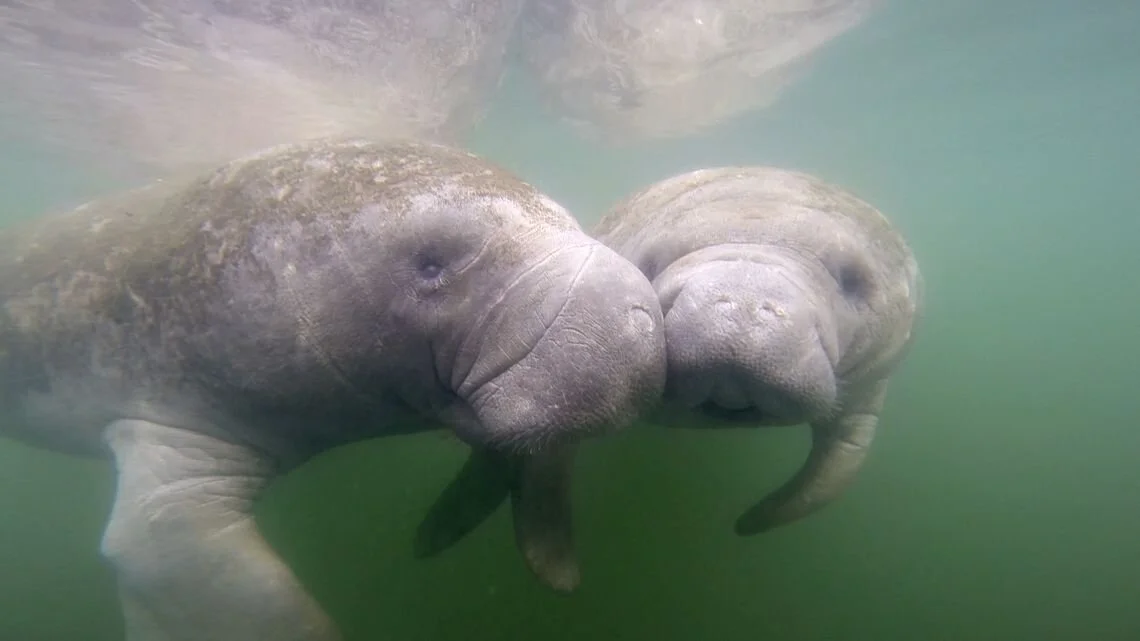
+ 10% of all sales goes to Save the Manatee Club
+ A tree is planted for each item sold via One Tree Planted
+ My dry cleaner uses an eco-friendly (non-perc) method
+ I use 100% recycled acid-free tissue to package your purchases
+ I have just started using compostable bags and recyclable paper ribbon to protect and wrap up your item
+ I print your thank you note on 100% post-consumer recycled paper
+ The shipping boxes and the kraft tape I use are recyclable
+ Etsy offsets 100% of carbon emissions from shipping
+ My web host is wind powered

earthhug.jpeg


Vintage fashion is the time-traveling, green, smart and beautiful answer to fast fashion.


Sponsored ad

2 Comments

Comment

Still looking for that union label

An ILGWU Local 105 woman sewing in a shop, c.1960-65

An ILGWU Local 105 woman sewing in a shop, c.1960-65

There was a time when many U.S. citizens, the majority women, made a decent living making clothing. This was in great part aided by the strength of the ILGWU (International Ladies Garment Worker Union).

As clothing manufacturers moved their garment work abroad for cheaper labor, the union work dwindled. This advertisement from 1978 may seem outdated, but the message still resonates.

Look for the union label
When you are buying a coat, dress or blouse.
Remember somewhere our union’s sewing
our wages going to feed the kids and run the house,
We work hard but who’s complaining.
Thanks to the I.L.G. we’re paying our way.
So, always look for the union label,
it says we’re able
to make it in the U.S.A.

The ILGWU didn’t just mean fair pay and treatment for its workers, the union also sponsored informational events, health resources, sports teams, choirs, and group travel.

ILGWU Local 295 bowling league, 1963

ILGWU Local 295 bowling league, 1963

English class for Spanish-speaking ILGWU members, c.1955-60

English class for Spanish-speaking ILGWU members, c.1955-60

Sewing class sponsored by ILGWU Local 91, October 21, 1966. All photos courtesy of Kheel Center on Flickr.

Sewing class sponsored by ILGWU Local 91, October 21, 1966. All photos courtesy of Kheel Center on Flickr.


You can still look for the union label, in vintage clothing.


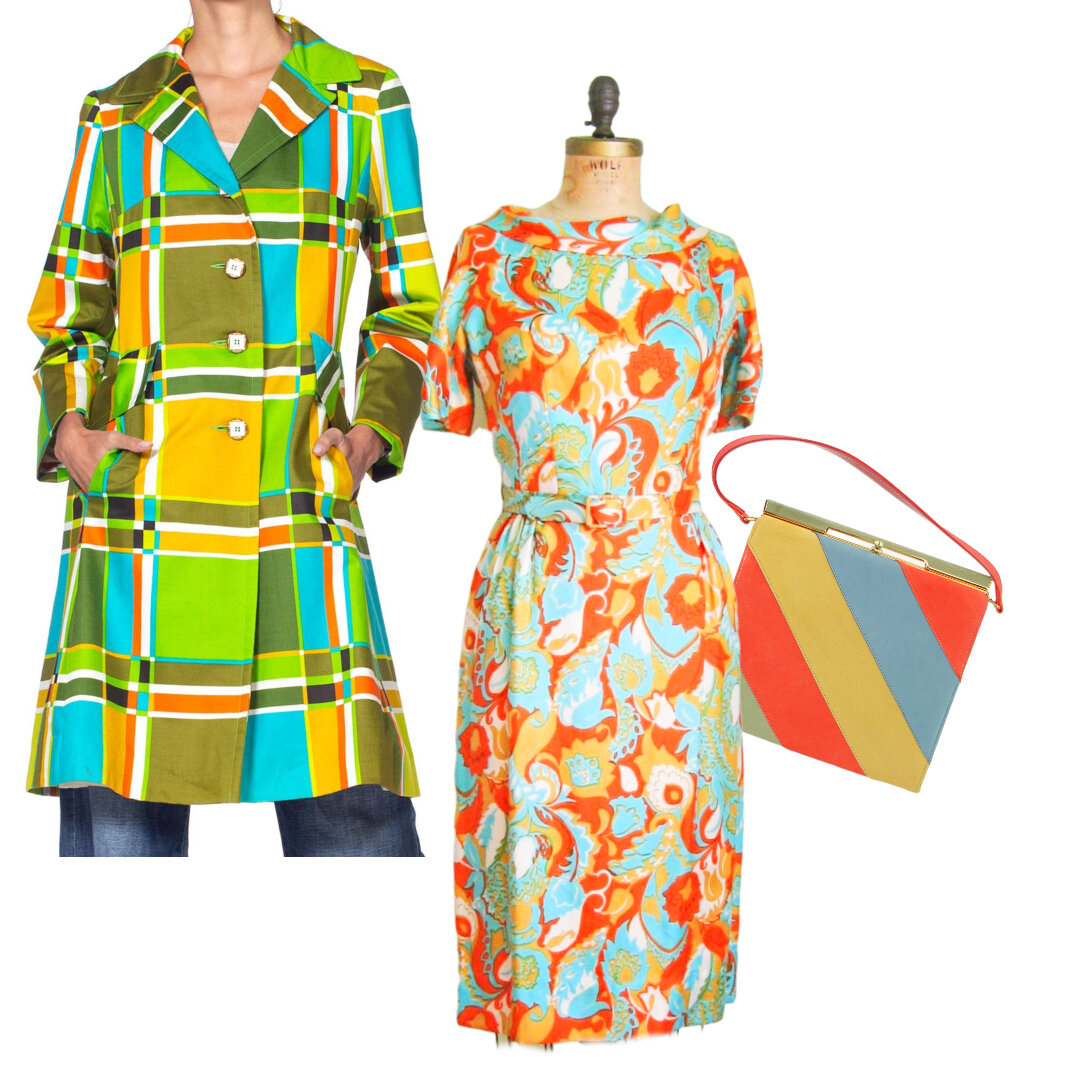
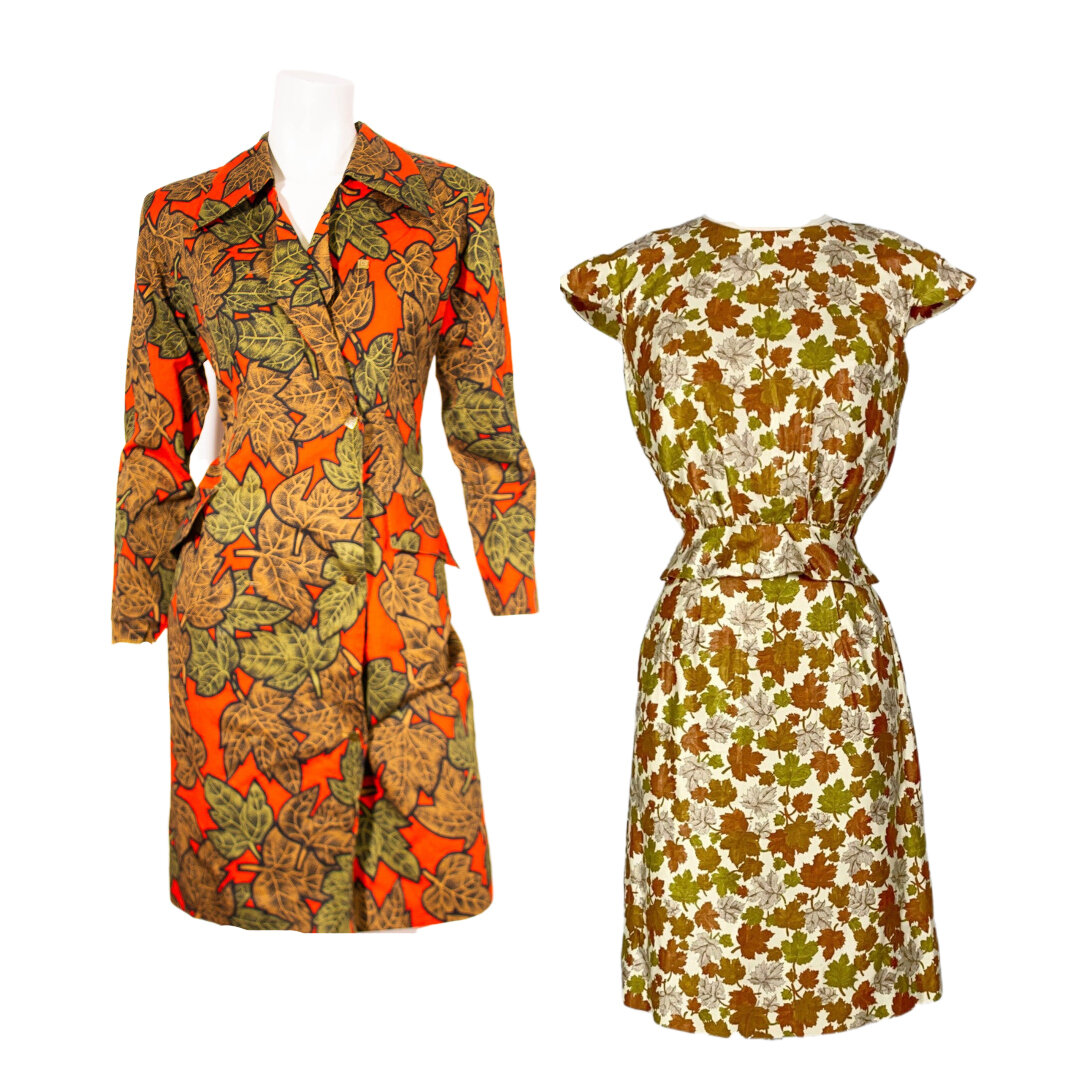
Just a few of the choices with union labels at denisebrain this week (click any photo for more on the item):

See many union labels and the information they give you about dating your clothing in the Vintage Fashion Guild Label Resource entry on Union Labels.
For the most complete history of the ILGWU, see the Kheel Center for Labor-Management Documentation and Archives in the ILR School at Cornell University.


Comment

4 Comments

A 1940s Lanz collection

giphy.gif

I recently came upon a number of frocks made by Lanz in the early to mid 1940s, all from the same household. Somebody must have had a great affection for Lanz.

But after looking at these, I have to ask, who wouldn’t fall for these charmers?

I want to show you the items, but first, a little about Lanz:

Joseph Lanz and Fritz Mahler founded the company in 1922 in Salzburg. It started out as a purveyor of ski togs and traditional Austrian clothing (Tracht). The founding corresponded almost exactly to the start of the famous Salzburg Festival, the music and drama event portrayed in The Sound of Music. Tourists from around the world, including many Americans, flocked to the festival and purchased Lanz clothes in the 1920s and 30s.

In 1925, Fritz Mahler left the enterprise, while Joseph Lanz expanded his operations. In the mid 1930s, he left the outfit in family hands, while he immigrated to the U.S. He set up Lanz manufacturing in New York, followed by Los Angeles.

From The Morning Call Allentown, Pennsylvania, 13 March, 1938:

Those blond Austrian mountain lads, who have made many an American girl’s heart skip faster, have now inspired some of her new spring clothes.

Lanz, of Salzburg, who began his career as a designer of ski clothes in his native Austrian village, has launched his first American-made collection with togs influenced by the clothes of Tyrolean mountaineers and peasant girls. 

The clothes have zip. Some of them are made of rustic linens and rayon suits, others of cotton prints, whose light grounds are splashed with figures from the picturesque Austrian Tyrol. Among them are “beer wagon prints” patterned with mugs of foaming ale and pretzels and “Tyrolean siesta prints” strewn with cows, milkmaids and boys dozing in haystacks. There is also a “Hansel and Gretel print” brightened with the fairytale children, gingerbread house and witch.

Here are the printed cottons used for the items I have for sale:

Teenage and college-age young women flocked to Lanz. They were manufactured in junior sizes, sold in the youth-oriented departments of stores, and advertised to the young.

From The Morning News (Wilmington, Delaware), 17 June 1941

From The Morning News (Wilmington, Delaware), 17 June 1941

From The Los Angeles Times, 4 June 1944

From The Los Angeles Times, 4 June 1944

Even though these were popular with younger women, they were not inexpensively made clothes. I can say from looking at them up close that they have lots of bells and whistles, including very nice quality fabrics and trims, signature heart logo buttons in silver metal, and cotton bias tape covering inseams that could both receive a lot of wear and could irritate the skin, such as waist seams. The zippers are good quality, the sewing and sizing is very consistent.

Amazingly, two of the dresses I am offering have their original hang tags—never used and stored to keep them as if they were just made!

This circus print dress? Never worn.

And the contented cows and milkmaids? Never worn!

These two sundresses came to me used, but certainly well kept.

The skirt and dress with the oh-so Sound of Music goat, chicken and flower print cotton have the sweetest red trims. The white eyelet cotton blouse has mother-of-pearl buttons and lovely flaring cuffs.

After Joseph Lanz left Austria, the traditional Tracht clothing was still made by Lanz in Salzburg, while the American branch became more fashion-oriented. These two divergent paths have continued for most of a century now and the story behind each vintage garment with a Lanz label can be challenging to distinguish. I rely heavily on the Vintage Fashion Guild Label Resource for this and all label referencing. You can see more about the history of Lanz and its numerous labels there: https://vintagefashionguild.org/label-resource/lanz/ while the Visit Salzburg website has a few words to say about the Lanz of Salzburg flannel nightgowns currently being made: http://salzburg-visit.com/travel/lanzofsalzburg.htm.

You can find these 1940s Lanz items in my Etsy shop while they last: etsy.com/shop/denisebrain

Many thanks to Roxy Louise Webster for her spot-on modeling of these wonderful togs. She looks like she was born to wear 1940s Lanz!

4 Comments

Comment

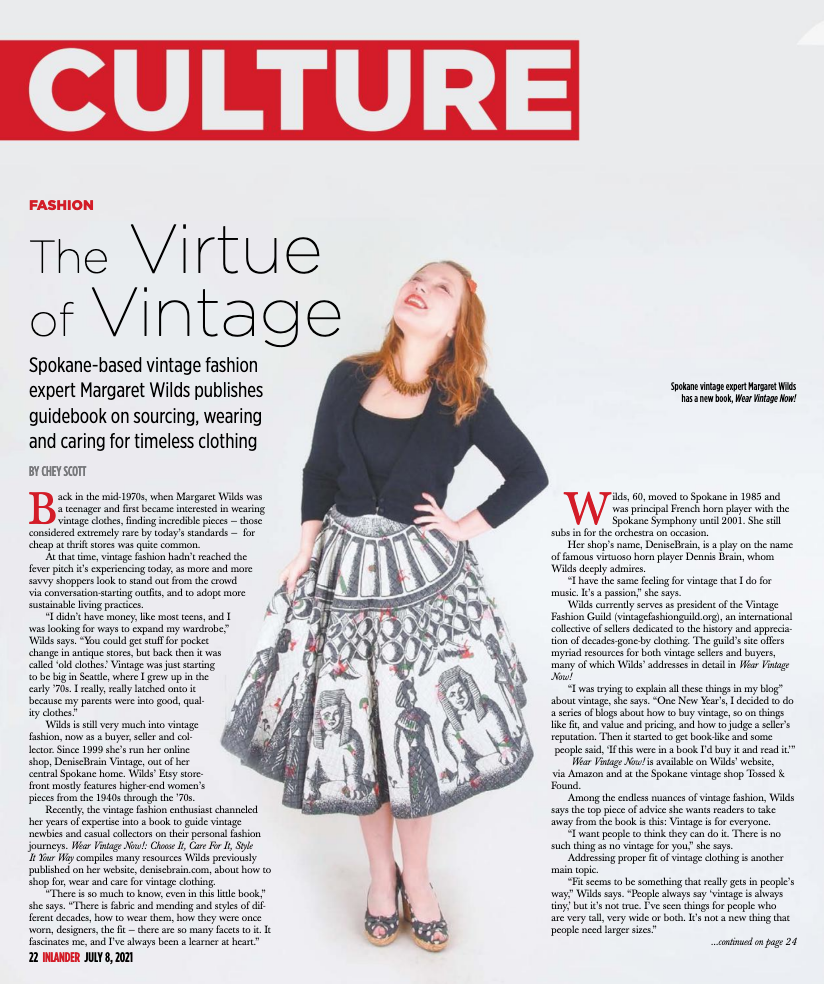
I'm (a tiny bit) famous!

This is an interview with Chey Scott for Spokane’s weekly newspaper, The INlander. I had a really good time talking at length with Chey about vintage fashion in general, and my book in particular. She was able to condense the discussion to the most important points.

Thank you Chey!

You can read this most easily here: The INlander

Screen Shot 2021-07-22 at 4.16.19 PM.png
Screen Shot 2021-07-22 at 4.16.49 PM.png

Comment

4 Comments

Print mixing with vintage fashion, part II

Leigh in all her bright print-mixing glory

Leigh in all her bright print-mixing glory

When it comes to print mixing I have a hero: Leigh Wishner is the Museum Registrar-Coordinator at FIDM Museum & Galleries. She wears prints and she wears them well—with confidence. Leigh also knows a lot about prints and textile history in general. Her Instagram account @patternplayusa is a fascinating and colorful appreciation of 20th-century American textiles and the stories behind them. A book is to come. I can’t wait!


I asked Leigh for a few sentences that would summarize her print-mixing philosophy. And, typical for her, she accommodated generously.

Pattern mixing—a fun, but understandably daunting, subject. The rules are there are no rules, but that said...there are "guiding principles" I think help it all make sense. It all boils down to scale, color, and pattern family.

There are two ways to mix prints of different scales: either extreme difference in scales (like small dots with giant dots), or very similar scales (let's stick with dots--two similarly sized dot prints, but of different colors). That's one way I look at things when I'm getting dressed. Two big patterns can look great together! Two micro patterns also have that capability. But a huge pattern and a small pattern together really work best when at totally opposite ends of the scale spectrum.

Color is the other pattern clashing/complementing factor. For me, one print usually picks up a color in the other print I'm wearing, like I have a William Morris print scarf that I like to pair with an Associated American Artists print that has overlap in terms of color and the motifs somehow "converse" with each other. Or, the colors don't "go together"—but there's something about the two dominant colors in the patterns that work in oppositions on the color wheel, like an orange-dominant floral pattern with a blue striped pattern. Or purple geometric with yellow gingham. You get the idea. Or totally monochromatic—a green leafy print and mod green chevron print sounds good to me!

"Pattern family" can be a lot of fun to play with! Let's say you have several different checked things on at the same time. Or vertical and horizontal stripes. Or two different florals. This is where scale and color can really help you determine what looks best! But clashes in pattern families also yield brilliant results—think tartan and leopard print, or polka dots and paisleys. I also like to think about how shapes and styles complement each other—like hard geometry with soft florals (which describes a pair of black/white stripe palazzo pants I wear with a pastel lavender silk floral tea timer). Or something with lots of curves and arabesques with something equally florid.

I also always start by picking the one garment that I want to "anchor" everything, and then work from there. It's a trial and error process that often means things are strewn about until everything is "just so"! I can get obsessive and I always need to see everything together to make a holistic "diagnosis" for how well something works out vs. how my mind pictures it.

And...accents of solid colors for accessories are good, but you can also extend pattern to purses, shoes, scarves, etc! But always: do what you feel most comfortable with. If you're not comfortable in your choices, you'll never feel as good as you look.

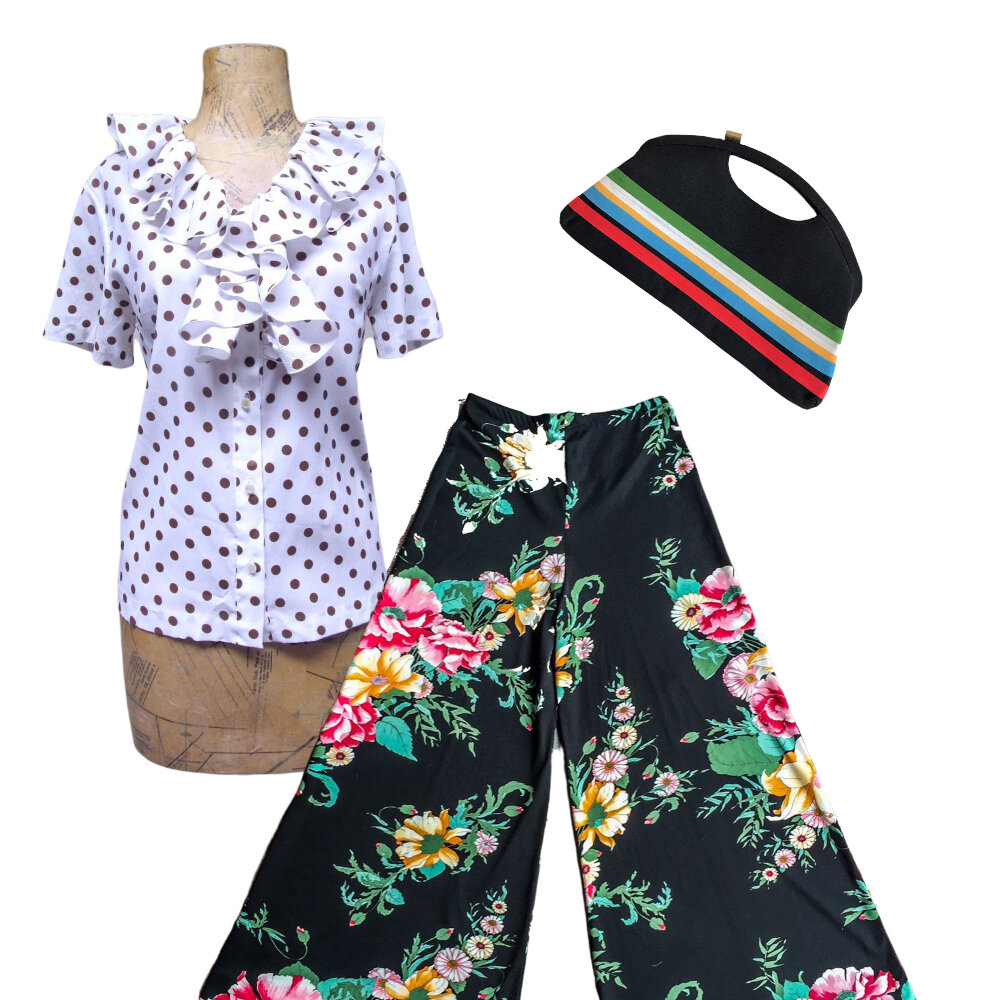
Equipped with Leigh’s ideas, I put together items from Etsy searches; many of these you will find in my vintage print mixing favorites collection. One of her ideas I really took to heart is to start with something you want to anchor your other choices.

And that reminds me: Choose a print (and item) you love! Duh, right? Well, that really is the first step with all vintage wearing. Sometimes I forget to say the obvious.

What do you think? Too much? Too little?

4 Comments

Comment

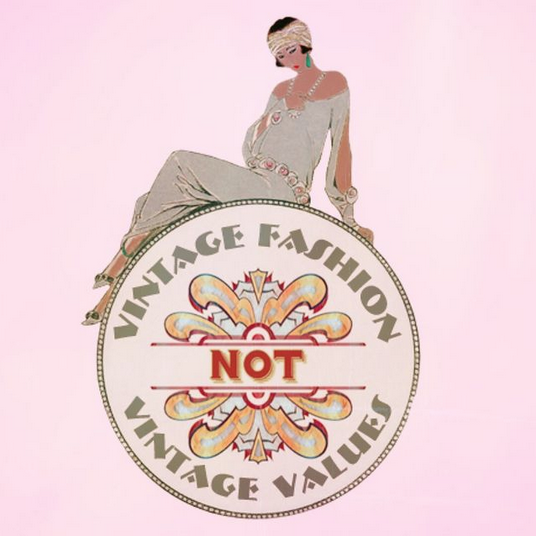
Vintage Fashion not Vintage Values

You may know I have long supported and advocated for manatees, and for women who need a hand to become economically independent.

But it’s not those I want to mention today. The year gone by since George Floyd’s death has affected me more than I would have expected. I lived through the 1960s Civil Rights Movement and everything that has happened since. By now I thought I’d seen all I needed for understanding and compassion.

Even with all I’ve seen, the events of last year reached deep inside me. I can’t look at fashion photos of the past without seeing the lack of diversity. I can’t help but notice how few Black Americans have made it into fashion history books, even when richly deserving.

It’s not enough to just care.

As Amanda Gorman spoke at the inauguration of President Biden—

It’s because being American is more than a pride we inherit,
It’s the past we step into
And how we repair it

Caring is a verb, and the work is ongoing.

#vintagefashionnotvintagevalues

(BTW, this is my design—how do you like it? I have it on a couple of items in a Zazzle shop, and am donating half of my proceeds on sales in the shop to Facing History.)

Comment

It's denisebrain's golden birthday!

8 Comments

It's denisebrain's golden birthday!

My dear friend Corinna informed me that this is my business’s golden birthday, meaning my business is the same age as the day it was started. I began denisebrain on April 22, 1999, so that makes this the 22nd anniversary—the golden birthday!

I’m all for celebrating this golden day with golden memories of all these years.

goldmeshbag20s(1)WandDBF.jpg

This bag was given to me by a friend to sell for her back in 1999. Made of 14k gold mesh, dating from ca. 1920, it belonged to one of the founding families of the city where I live. I traveled and sent inquiries around to get this bag a good home, but everyone wanted to pay its “melt value” because they said it was worth more as gold than as a bag. My friend and I wanted it to be loved and appreciated as a bag—and we finally found it a home that wanted it for its beauty and its history.

 
earlylighting.png

In the beginning, there was flash photography—that or blinding sunlight on a nice day. When I started selling on eBay back around 2000, no one used a real person to sell fashion. I am the world’s oldest child playing dress-up, so while trying things on I thought why don’t I photograph items on me? I’m not a model by a long stretch, but I can give the fabric life. I set up a little studio space in the corner of our living room and put my camera on a tripod with a timer.

blackwithgold.jpg

The sophistication of my photography gradually grew along with my knowledge of vintage fashion.


I love vintage fashion, not just to wear, but to learn about. I’m passionate about fabrics and the beautiful-quality embellishment and workmanship you can often see.

qualitymaterials(1).jpg

(You can’t tell I enjoy my work or anything, can you?)

havingtoomuchfun.jpg

I love the way vintage allows you to imagine the lives of people who preceded us—to literally walk in their shoes.

shoes.jpg

When did she live?

timeline.jpg
playingroles1.jpg

Was she a bridesmaid? A playwright? A lawyer? A rock star?


What was in her bag?

bags.jpg

I’m certainly not making a ton of gold, but through my business I have been able to give quite a lot to causes near and dear to me: The environment, women who need a hand to improve their lives… and most of all, manatees. With the help of customers and colleagues who care, I’ve been able to raise over $12,000 for Save the Manatee Club, and help raise awareness about this beloved species’ endangerment.

giving2(1).jpg
queen.jpg

I have been the queen of my own fate all these 22 years.

 
bollywood(1).jpg

The experience so far? Pure gold of course!

 
future(1).jpg

I can’t imagine what will happen next—but I know it will be interesting.


Thank you to all who have been with me on this incredible journey so far—the friends I’ve made through vintage, my vintage fashion colleagues, and all my wonderful customers. Here’s looking at you, 22!

toasttogoldenbirthdayconfetti.png

And of course it is Earth Day too—so please don’t forget that vintage fashion is the most beautiful of recycling! Whether you carry a bag of pure gold, or wear a hand-knit sweater from the 1970s, you’re helping the earth and saving our resources.

8 Comments

Update on manatee fundraiser + Manatee Appreciation Day

2 Comments

Update on manatee fundraiser + Manatee Appreciation Day

March 31 is Manatee Appreciation Day

There couldn’t be a better day to give these gentle giants our advocacy.

Over on GoFundMe, I am raising $1,000 for manatees, and we’ve reached a total of $650. So many generous donations have brought us this far! It would be absolutely wonderful and so appropriate to raise the remaining $350 on March 31. Are you able to spare $5 towards this goal for these wonderful animals?

If you’ve seen the news about manatees recently, you’ve probably had to look away. So many are dying that this season may reverse years of progress in manatee recovery. It’s gut wrenching.

My GoFundMe page directly supports Save the Manatee Club and its emergency efforts to save and protect manatees and their environment. The organization is the voice for manatees.


2 Comments

Manatees need our help

Comment

Manatees need our help

Please help me raise money for the Save the Manatee Club. The cause is urgent right now.

I imagine many of you know that I give 10% of my denisebrain sales to Save the Manatee Club—manatees are a year-round cause for me. Their survival is precarious because of the things we as humans do that cause manatees harm. But there is a special urgency this year.

This winter season has been devastating for manatees, with more than 430 dying since the beginning of the year. Many appear to have starved to death. Their winter safe havens are so polluted that their food sources have been choked off.

I have set up a Go Fund Me page to raise emergency rescue funds for the Save the Manatee Club. If you go to that page, you can read more about this issue, and find more ways to help. Please, if you can, make a donation. If you are not able, please share the page: Manatees: Unprecedented Need.

Manatees have been around for between 30 and 60 million years. We can't let human carelessness and selfishness wipe this gentle and intelligent species off the face of the earth.

Comment

The Magtone Color of the Moment: California Poppy

Comment

The Magtone Color of the Moment: California Poppy

You’ve probably seen the Pantone Color of the Year—for 2021, it’s the pair Ultimate Gray and Illuminating. They make a fine team.

But as usual, I have something else in mind. A good name for the color is California Poppy because it is a love letter to California and its hills covered in wildflowers. It is both urgent and hopeful. It’s also just plain beautiful.

Photo: Philip Bouchard via Flickr

Are you feeling California Poppy too? Here are some Etsy vintage fashion picks featuring this vibrant shade. You can see more in my Etsy favorites list California Poppy.

Comment

Comment

The Importance of Measurements in Choosing Vintage That Will Fit

Of the handful of Really Important Issues when choosing vintage clothing, fit is probably number one for most people.

BeFunky-layer.jpg

There is no standard by which vintage sellers collectively describe sizes, but let’s be fair, there is no precise standard for modern clothing either!


Sometimes you’ll see a vintage item that has its original tag or label with the size marked on it, but don’t confuse this with current sizing. Vintage sizes do not coincide with modern sizes, nor are they predictable when compared with other items from the same era. In her study of advertisements in Vogue magazine from 1922 to 1999, Alaina Zulli found a great deal of irregularity, with a generally decreasing size number through the decades, due to so-called vanity sizing. As summarized in 2011, Ms. Zulli found that in the Sears catalogue of 1937 for instance, a woman with a 32" bust would have worn a size 14. She would have worn a size 8 by 1967, and today, she’s wearing a size 0.* Fit is all about measurements, not stated sizes.


I have tried to at least codify my own modern size estimates for the vintage items I have for sale, based on an assortment of websites’ and catalogues’ size charts. Other vintage sellers have done something similar. However, I would recommend that if you see U.S. size 6, say, or XL, even in my listings, do not assume it is the same as your idea of size 6 or XL. Go straight for the measurements and compare those to your own.


Many sellers, including me, suggest that you compare the measurements of an item you’re interested in with something similar of your own that fits you well.


When should you ask for further help from an online vintage seller? By all means ask if there are no/not enough measurements. A seller who offers almost no information may be a beginner or simply not very skillful. One characteristic that good sellers share is that their listings include most or all of the information you need to make an informed decision. Most good sellers will be happy to guide you if you need further help with the size or some other aspect. Just remember, don’t ask if that 1950s dress is a size 6—ask about the item’s measurements.
Copyright denisebrain

Copyright denisebrain


So now that you understand the importance of measurements for fit, here are the most common measurements you will need for clothing.

It is an extremely good idea to have someone help you with these measurements, at least the ones that would require advanced contortionism to manage on your own. Use a cloth measuring tape and keep it straight and snug but not tight as you measure. Stand tall and relaxed and don’t suck in, especially for the bust and waist measures.


Bust: With your bra on, measure around your body at the fullest part of your bust.

Print out to record your measurements

Print out to record your measurements

Under-bust measure: Measure around your body just under your bust.

Waist: Measure around the smallest part of your waist, just above your belly button.

Hips: With heels together, measure around the fullest part of your hips, about 8" (20.3 cm) down from your waist.

Shoulder width: Imagine lines going straight up from your armpits to your shoulders in back. Measure from this point on one shoulder to the other, across the back.

Outer sleeve length: Measure from the tip of your shoulder to your wrist along the outside of your arm.

Upper arm: Measure around the fullest part of your upper arm.

Neck: Wrap the tape around your neck about 1" (2.5 cm) above the point where your shoulder meets your neck.

Back waist length: Measure from the base of your neck to your waist in back.

Inseam: While standing straight, measure from the groin to the place where you would like the hem of the pants to fall (ankle or floor).

Outer leg length: Measure from the waist to the point where the hem of the pants will fall.

Rise (front and back): Measure from the groin to your waist at center front for the front rise, and at center back for the back rise.


You can be any size and look great; you just have to be honest about the size you really are.

For instance, when you measure your waist, don’t suck in or you’ll have to live with permanent duck face while wearing too-tight clothes. If you lose that weight you’ve been meaning to lose or whittle your waist with exercise, you can find a new vintage frock or alter what you have. But now is now—and you deserve to look and feel great right now!

This post is excerpted from my book Wear Vintage Now! Choose It, Care For It, Style it Your Way. In the book you will find further help with fit, considering such subjects as ease, vintage underpinnings, and alterations.


*Clifford, Stephanie. “One Size Fits Nobody: Seeking a Steady 4 or a 10.” New York Times, April 24, 2011.

Comment

Whiting & Davis Forever

Comment

Whiting & Davis Forever

goldmeshbag20s(1).png

The very first vintage Whiting & Davis bag I had my hands on was one that gleamed with real gold.

It dated from the 1920s. Since then I’ve had the fortune to find a great variety of Whiting & Davis bags and other items of their famous metal mesh material.

Founded in 1876, their first metal mesh bag was made in 1892, and the business continues to this day. Vintage Whiting & Davis items have been collected and worn by fashion icons and everyday people for decades, while current styles (still of their famous metal mesh) make new fans.

Whiting & Davis history

Right now you can find the 1970s golden bib necklace in my Etsy shop, or for a little less in the Vintage Fashion Guild Shop on Facebook.

Comment

Denisebrain best of 2020

Comment

Denisebrain best of 2020

For the past 14 years I’ve rounded up favorite vintage sold in the year gone by, so this blog is just the latest in a series. However there’s never been a year like 2020 before. January 2020 seems like years ago, doesn’t it?

With my psoriatic arthritis making it hard to do my own stunts, I’ve been getting modeling help with my listings for several years now, and this year I finally had to start relying on myself again for new images due to pandemic precautions. I found it personally helpful—smiling at a camera has had an uplifting effect on me. I hope you have found something to lift your spirits in this most difficult of years. Maybe this gallery will provide you a reason to smile.

If I had to pick my customers’ favorite color of the year, surprisingly (or maybe not!), it seems to have been yellow. There is a fashion trend toward yellows, specifically bright marigold, and one of the Pantone colors for 2021 is a bright yellow they call illuminating. It feels hopeful.

Soothing lavender was also popular.

I guess it should come as no surprise that vintage tops might be, well, tops with buyers in a year when our primary mode of face-to-face contact was through the computer.

Likewise vintage robes and lounge wear: A blue velvet robe from the late 1930s? It sure beats sweatpants!

My book Wear Vintage Now! came out at the beginning of the year, and it has made a lot of friends. I heard about it being a beach read, a convalescence read, and a comfort. One customer wrote “In these strange times, this book keeps me sane and makes me happy. I just love it and adore the personal touches.” I hope you have or will pick up a copy for yourself.

Now here’s a perennial: It doesn’t matter what year it is, novelty prints are favorites.

Mod fashion always seems forward-faced and upbeat. May it be a harbinger of good to come.

In 2020—for sitting in one’s own backyard, or taking a stroll—I offered sunhats. These date from ca 1920, 1940 and 1960.

Then there are the four 49ers (don’t anyone sing three french hens, two turtledoves…). Since I live relatively near Pendleton’s home in Oregon, I have the good fortune to find their famous jackets, made starting in 1949. Bonus: They are put-together yet comfortable.

Another perpetual vintage favorite, and a good reminder: Flowers mean spring, which means hope.

I can never have enough green to offer, especially on the beautiful red-haired model Selah. Nothing flew out of my shop faster than that early 1940s yellow and green dress by Lanz.

STMCLogo.jpg

Once again this year, I have donated 10% of my profits to the Save the Manatee Club. The organization kindly informed me that over many years, I have been able to donate over $12,200 for the protection of this beloved species. I will always continue with this, and I’m so grateful for all the support I get from caring customers, readers, colleagues and friends.


dress-for-success-logo.jpg

Through the Pink Heart Shop of my Etsy store, I also continued to support Dress for Success in their mission to economically empower women all over the world. This has been a crisis time for many of their clients, and I was glad to offer what I could to help.


Next: To say that late 1930s to early 1940s hats are interesting is unnecessary. Just look at them. This is one of my favorite categories of vintage fashion so this year I gave myself the pleasure of showing these.

There were some mighty spectacular beaded items this year. The 1970s Sister Max dress in the first photo weighed an astonishing five pounds. Sarah (the gorgeous model) said it was her favorite thing she’d worn from my stash of vintage.

More comfort! This time via soft wool bouclé knits.

Beautiful Bakelite, Lucite, acetate surah and rattan—they all run circles around modern equivalents.

And one more vote for spring (you may call me a petal pusher): Alternative petals.

I loved the pink hat’s review “If a hat were to be designed for me, this would be it. It is exquisite. This is a hat that makes me happy.” Isn’t that what vintage fashion is all about?

This was a tough year. Many of us were alone, but we were alone together. If I had just one wish for the year ahead, I’d use it to wish that we would all understand that we are together in everything. Whether it’s wearing a mask and keeping a safe distance for each others’ health and safety, or watching out for neighbors who are less fortunate, or standing by people who are not treated equally, or caring for our planet.

Since I have more than one wish, I wish you and yours a healthy, safe, and hopeful year ahead.

My best to you,

Maggie of denisebrain

Comment

Comment

Warm and pink wishes

pinkVogueAnim.gif

Wintertime is here
Let us clink a drink
Cuddle up in vintage
And catch an extra wink

My wish for you is simple
And it is succinct:
Warm and happy holidays
And a new year in the pink!


Here’s to making 2021 a vintage year!

💗
Maggie of denisebrain

Comment

1 Comment

My book makes a great gift (hint, hint)

My book Wear Vintage Now is not quite a year old, and it has been selling slowly but surely, making new friends all the while. I’m very happy at the positive reaction it has earned from so many different sorts of people: Vintage beginners, experienced dealers, buyers, writers, and even experts—people of all ages. Check out some of the reviews.

The book has a lot of information, and a lot of photos. It is concisely educational but also fun. People tell me they have gone back and back to it.

That’s why I feel confident that the book would make an excellent gift for the vintage fashionistas on your list this holiday season! I know, I know, I would say that, but I feel very strongly that you won’t be disappointed.

The book is available to order from just about everywhere, but if you purchase the book from here on the denisebrain website or from my Etsy store, I will sign and send the book to you personally.

If you want to try your luck at winning a book, I will be giving away two of them at noon on Saturday, December 5, on Instagram @denisebrain_vintage. All you have to do is comment on the post that shows a photo of my book.

1 Comment

Comment

Manatees have a month

And November is it

Of course manatees are to be celebrated and cared about all year, but November is a special month for them. Since 1979, November has been set aside as Manatee Awareness Month.

This is the time of year in which manatees move in from their warm weather migratory routes to hug the shoreline. The natural warm springs and power plant effluents to be found there don’t just make manatees more comfortable—as a sub-tropical species, they need water above 68 degrees Fahrenheit to survive. As the animals move closer to the shore, there are inevitably more boat strikes, fishing line entanglements and pollution poisonings that lead to injuries and deaths for manatees.

Without natural enemies, humans do manatees the greatest harm. So I believe we must also be their biggest advocates.

Manatee Awareness Month.jpg
manateehugger1c.jpg

One thing you can do for manatees: Wear vintage fashion.

Wait, what?

Not only are vintage items a beautiful form of recycling, but you can specifically help manatees by purchasing vintage fashion from me! I donate 10% of all denisebrain sales (not profit, but sales) to Save the Manatee Club. I began this on September 7, 2016. Before that, I raised funds and awareness for manatees at various times of the year, but I felt I had to do more.

I am not wealthy by a very long stretch, but by consistently putting a little towards helping manatees, and with the kindness and generosity of my customers, over the years I have been able to donate over $12,200.


Would you help me raise a little more for imperiled manatees?

I have set up a GoFundMe page with the goal of reaching $200 in donations by the end of November. I know it is hard to put together any extra money these days, but take it from me, if you have $5 to give, that little bit can help add up for this magnificent species.

Long live the manatee!

Comment