Comment

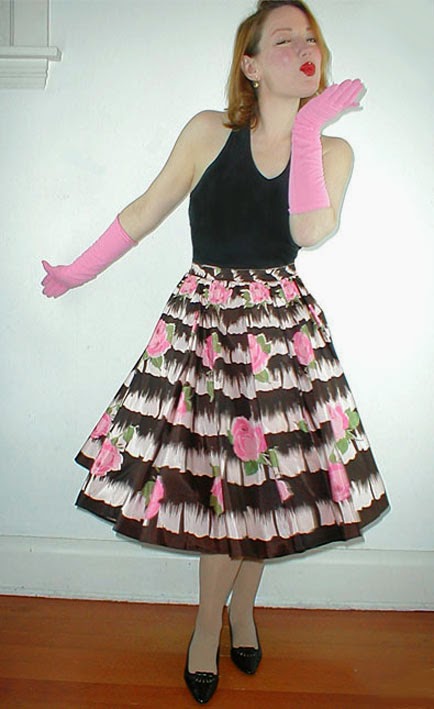
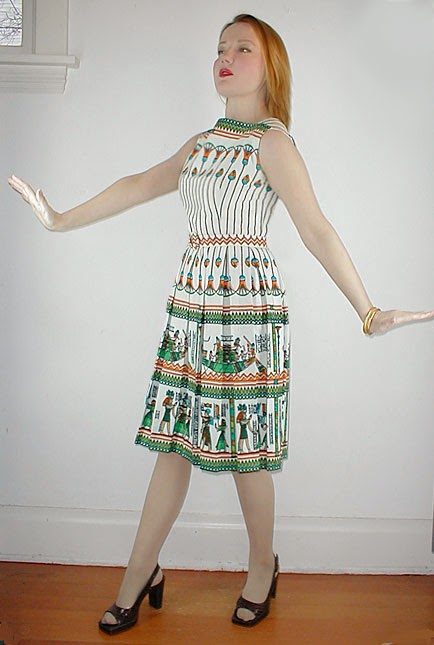
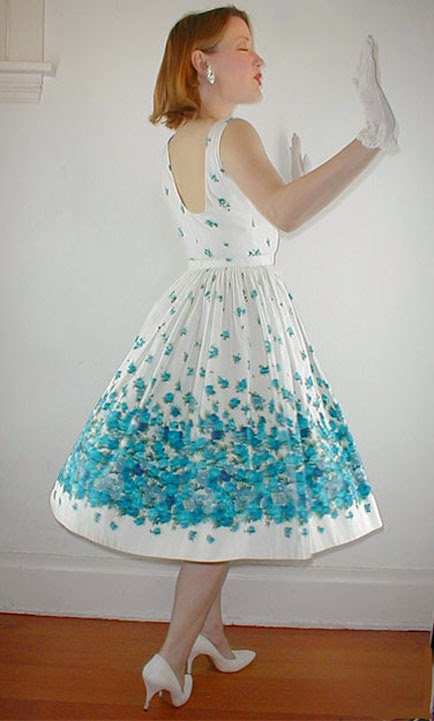
Clearing rack space sale

You know when you have too much of a good thing? 

I am extremely low on vintage clothing rack space in my storage and home. Would you help me make a little room? 

Now through Friday, June 6 all my items over $20 are 20% off. 

If you purchase from my Etsy shop, use the coupon code MAKESPACE for the discount. If you purchase from my web store, I will refund 20% of the item price just as soon as I can. 

Etsy shop

Do yourself and me a favor—*wink*

Comment

7 Comments

Flowers for my mother

This is a repost from a few years ago. My mother means still more to me today.

I know a lot of people say this, but sorry, I really am the one who had the best mother ever

...at least that’s how it seems to me. She was different from me in many ways, and in so many ways I learned and got to be a better person because of her. Not a single day goes by that I don’t think of her. I strive to do things as she would do them. Most every day I miss her and wish I had new times with her.

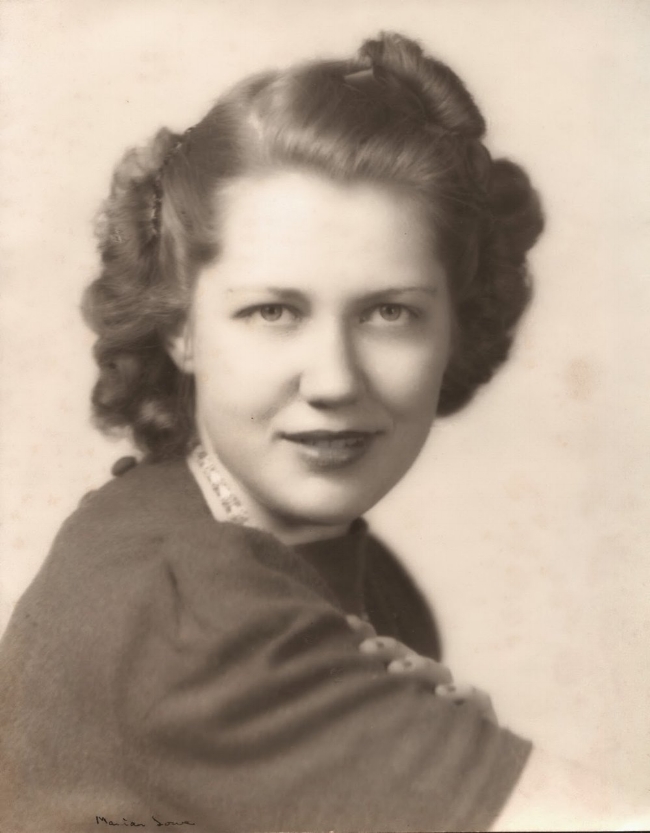
Marian Enid L. was born September 28, 1920 in the small town of Grimes, Iowa. Her father was a banker during The Depression, and it had to have had quite an impact on Mama that her father worked to keep farmers in business, and keep their farms operating. Eventually he was let go for not foreclosing as expected by his overseers.

Mama at age six

Mama at age six

My mother always looked out for the less fortunate. She was the most open- and fair-minded person I have known personally. She did not apparently see race, class or gender as anything other than man-made obstacle or advantage, although she always looked after the underdog. Many mothers are naturally nurturing to their own children, but my mother had nurturing feelings—and took action on those feelings—for the entire world.

At Mama’s memorial service in 1988, there were many young people of all races and walks of life who considered my mother their honorary mother. She counseled, she listened, she advised, she taught, she made people feel welcome and special. She found people who needed her, and they found her.

Mama baked bread. She baked literally dozens of loaves per week and gave away much of it to neighbors, friends, and fellow office workers. The entire neighborhood smelled like a bakery on Saturdays. When she went to work on Mondays, she carried two big shopping bags full of bread on the bus. (My mother didn’t drive and was an intrepid mass transit user in Seattle where I grew up.)

Mama devised a recipe for bread that would offer as much protein as an egg in just one slice. She wanted to see this recipe be used to help feed people in need, as she figured it was about 7 cents per loaf to make. Her bread, and all her cooking, was unbelievably delicious.

Serving dinner to my father and his mother

Serving dinner to my father and his mother

My mother was adventuresome in her cooking, trying all kinds of new, good things. She remembered vividly the evening in the 1940s when she first ate garlic, and she was the first person to try many things at home. She read, watched and experimented with what Julia Child recommended. She was friends with the fish monger. She made a huge assortment of Christmas cookies each year, and made the most spectacular dinners any person could be privileged to eat. I created a cookbook of her recipes when she died, as I knew this aspect of my mother’s life was most tangible and cherished, and would be greatly missed.

Serving food at a friend's wedding in 1981

Serving food at a friend's wedding in 1981

I learned to do so many practical things because my mother took the time to teach me to do them: I learned to cook of course, and to sew, and to garden. With her college degree in romance languages she helped me learn French, and as a top math and science student...well I needed all the help I could get! My mother was extremely smart.

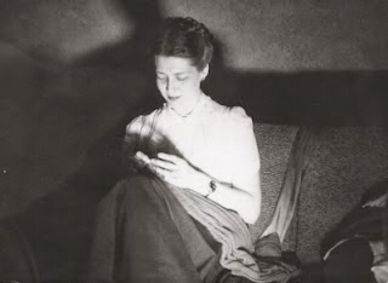
Knitting... (ca. 1950)

Knitting... (ca. 1950)

...and gardening (1961)

...and gardening (1961)

She didn’t have fancy taste in many things, but she had refined taste in music and literature. She played cello through college. She was a devoted reader and history was her favorite subject. Lincoln and Jefferson were her favorite historical figures, and she read and re-read Churchill’s writings. My mother avidly recycled, but before she let a single newspaper go she made sure she had read every word of it. She was unafraid to be political, and caucused for her candidates, went door-to-door for causes and talked to friends, as well as those in disagreement with her. She insisted I take issues to heart, to others and to the street. She was brave and strong in her convictions.

My mother didn’t swat bees, but carried them out of the house by their wings. She once went a few days with a broken arm without going to a doctor, because “it just didn’t hurt that much.”

My mother loved to have fun too. She loved movies, games, laughing. Her laughter took over her entire body, with tears streaming down her reddening face. Even though she was older (40 when I was born) she was a lot of fun for me and my brother, always taking us to parades, the zoo, the park, movies—she put up with seven showings of Mary Poppins for me. She always bought us balloons and cotton candy.

After my father died in 1974, my mother had to go back to work, and reentering the work force at the age of 54 could not have been easy. She not only found work at a law office, but became invaluable, a paralegal in all but title and salary. During the last year of her life, when she could no longer make it to work, office staff came to her home to get help managing the business. She didn’t make a lot of money, but when I was choosing a college she said to go where I most wanted to go, and we would make it work. My mother said “money isn’t the only currency.”

On the last Mother’s Day Mama was alive, we went to a garden center where I bought the annuals she picked out, later to put them in the dirt around her duplex. If it weren’t for the shopping cart, she couldn’t have walked, as she had some serious health issues. Still, as usual, she didn’t complain at all, and spent the time telling strangers what great children she had. She said what she always said, “Mother’s Day is the day that I am most thankful for having such wonderful children.”

The feeling is mutual Mama! I love you so much.

7 Comments

3 Comments

Make do and mend: 50s skirt tear

Still gloating over my success with stains reported yesterday, I decided to tackle a favorite skirt of mine.

This is one of the few items that I was set to sell, then saw the photos I’d taken and just had to keep. This skirt, dating from the 1950s, is black acetate taffeta with a beautiful flocked pattern. There is an attached black tulle crinoline and the waistband is comfortable elastic with a black velvet surface.

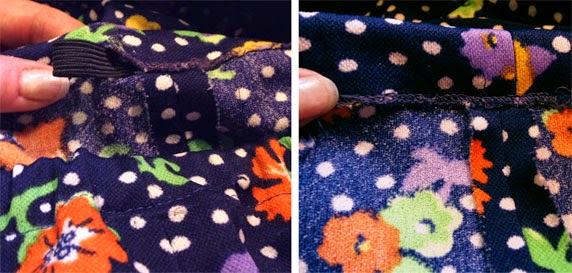
Because of that waistband the skirt is uncommonly easy to wear...and vulnerable. The vulnerability is that when the elastic is stretched, the fabric to which it is stitched can tear. One fairly big tear had been mended by a previous owner.

I often like to imitate how an item was made when repairing, or even follow the lead of a previous mender. In this case I find the mend a tiny bit franken-skirt and I’m not particularly thrilled with the taffeta being sewn to the tulle on the inside. You can see the top of this mend has given out.

This is the newer rip that has developed for the same reason.

I am no expert on this type of repair, but I think it could use a little backing for security. I ironed on dark fusible interfacing with the help of a press cloth, then pick-stitched around the tear. Finally I hand sewed across the opening with moderately small stitches. 

I feel it is nicely secure and reasonably inconspicuous (many thanks to that flocked pattern). Would you have done this differently? It would be great to know the best mend in case I spring another leak. 

 I’m not sure how long this will last but I hope forever, because I love the skirt!

3 Comments

6 Comments

Make do and mend: 3-for-1

I have been running a chemistry experiment of sorts for a week.

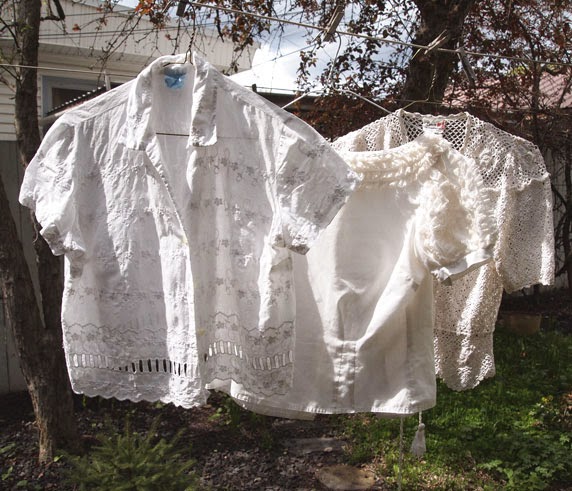
I have three very favorite vintage white blouses (two made of cotton and one poly/cotton blend) dating from the 1940s and 50s. All three of these I wore quite often more than six years ago. Their lengthy careers ended abruptly when somehow they got into a warm wash load with bleach.

Have you seen what happens to very subtle underarms stains when they are bleached? Those subtle underarm stains turn an angry shade of yellow that refuses to be removed.

Yes, denisebrain sweats. There I said it.

However I love these three blouses so much that I kept them on the off chance I would find a new solution to their problem.

Because of my resolve to help my fix-me pile this month, I decided to give many solutions a try on these blouses. I like to start from the least toxic alternative and work my way into the nasty stuff.

First it was baking soda paste (with water). If you have unbleached fairly recent underarms stains this can work, but for me this time...nada.

Then it was a slightly diluted white vinegar soak. The blouses smelled like tossed salad and the stains didn’t budge at all.

Next I got out other non-bleach stain removers. Ammonia has been recommended to me by dry cleaners for washable sweat-stained clothing. I gave the ammonia several chances. Then I used Pit Stop, among other things.

PitStop (now called Raise) is, for many cases of recent sweat stains, very effective on washable clothing. However, I’m truly disturbed that the ingredients are not listed on the bottle. Thanks to an about.com page by Mary Marlowe Leverette, I know that the active ingredients are:

- sodium hydroxide, also known as lye or caustic soda

- cocamidopropyl betine, a synthetic surfactant derived from coconut oil and dimethylaminopropylamine

- EDTA or Ethylenediaminetetraacetic acid, a polyamino carboxylic acid

Rubber gloves, open doors, a breathing mask and multiple attempts later...nothing. It didn’t even begin to budge these old bleach-set stains.

Finally in desperation I searched online using terms like “stubborn,” “old,” “bleach-set,” “impossible,” “horrendous”... OK, so I exaggerate slightly. I found The Art of Manliness blog on the subject. With the writer’s six year-old yellowed stains he had no success with ammonia but he had great success with a less toxic solution: OxiClean.

So into the OxiClean went my blouses. In two full days I saw maybe some letting up. In the meantime, I could at least breathe around the soaking solution, so I let the blouses stay in the solution for five days. After five days...100% success! The blouses are cleaner than the’ve ever been and those bleach-set sweat stains finally packed up and went home.

I could practically cry for joy to get these favorite blouses back! It is true that the more epic the effort the better it feels to achieve the goal. I feel pretty good!

Do you have any fabulous stain removal tricks?

Come on, I just told you one of mine! 

6 Comments

Comment

Make do and mend: Old friend edition

It is now day six of my 12-Day challenge to clean or mend 12 items from my own wardrobe. Because for my business I fix a lot of clothing issues, I never get to my own. Or I never used to—but now I’m almost in a habit!

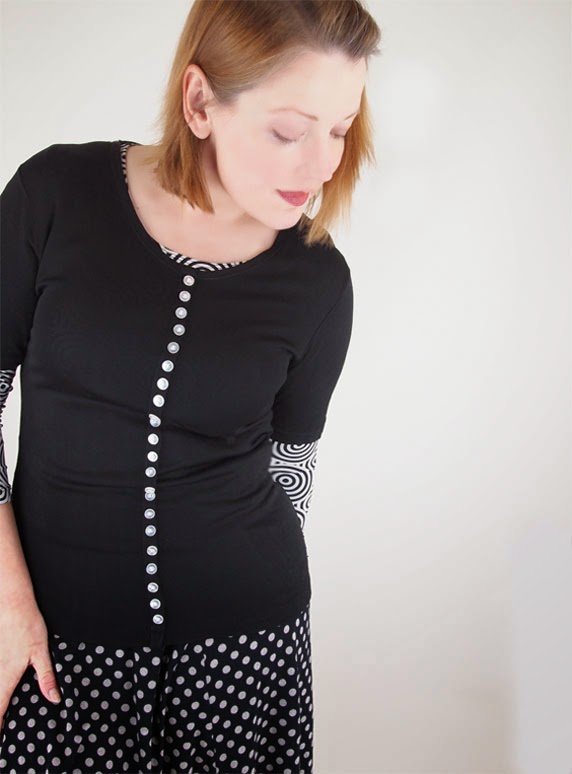
Today I come to a 1970s knit top that has been at the bottom of my mending pile for quite some time. It is nothing fancy and it appears to have been worn quite a lot before it came to me. It was someone’s old friend. It is hard not to love that row of buttons down the front.

I found the top at an estate sale some time ago. I was gathering up vintage clothing when I saw some photos on a bureau and realized that I was in the house of a friend of mine who had passed away a year before. I didn’t know this was the family home in which she grew up and I didn’t recognize the clothing, but when I inquired I found out that this was my friend’s very closet as a teenager.

Of course I had to keep this top. Not only does it have a delightful row of white buttons down its front but it was an old friend—of an old friend.

The top is black nylon knit and it had two not-so-tiny holes on the side front. The hem was stitched with that undependable 1970s plastic thread. One pull and it is out of there, so although only a stretch of hem was missing, I decided to resew the whole thing by hand. Because of the stretch knit I kept the stitches loose enough for give.

 The top is washable but tends to get lots of wrinkles, as you can see.

I sewed the holes up with basically the same technique I use for all knits (here is a tutorial from Lady Ott). The smooth fabric shows a mend but once I had steamed the top (smoothing out the fabric’s wrinkles was easy with a steamer) they weren’t conspicuous.

Now it’s ready to go again.

Comment

Comment

Make do and mend: Broken zipper edition


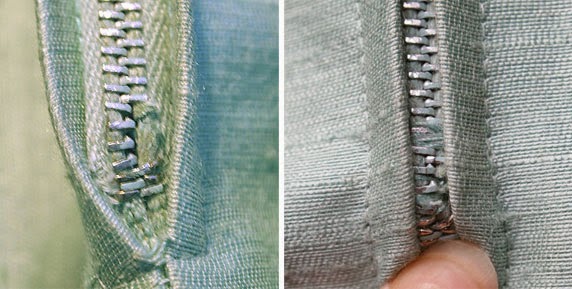
I have this 1960s pale aqua blue cocktail dress made of elegant silk and wool alaskine. Somehow the metal zipper lost a tooth and became derailed. It’s a sight I hate to see!


Actually, fixing a derailed metal zipper is almost always possible but it can be a bit tedious, so it’s not my favorite repair. While looking at others’ techniques online I found a great idea for just this issue. I used to try to slip the zipper pull back on at the point of the missing tooth. This sometimes took some patience.
Then I found a tutorial calling for snipping a tiny slit below the last tooth. If you have a missing tooth right near the bottom of the zipper this is a huge time saver. The zipper pull was back on track in seconds! Then I just had to whipstitch over the bottom of the zipper a tiny bit above the missing tooth/slit. I also stitched over the very bottom of the zipper as inconspicuously as I could so there would be no gap.

Now here’s a sight I love to see:


Cocktails anyone?
Aqua pearl cocktail from Epicurious.com
Thanks to Kyliie’s Thread for the idea!

Comment

Comment

Make do and mend: Earth Day edition


It is day four of my 12-day mend/fix/clean challenge. Today I’m very glad to keep an item going, because on Earth Day I am especially interested in making do with what I have.

I found an early 1970s suit in a thrift store in 1999, the year I began my vintage clothing business. I saw that it had no buttons on its jacket but I immediately loved it, took it home, found some white buttons to sew on and have worn it all the time since.


Yes it’s double knit polyester, yes it’s loud. On Earth Day about six years ago a music colleague of mine asked me if I would like to join in the local Procession of the Species wearing the outfit. Apparently I looked to him a bit like a wild critter of some sort. I took that as a big compliment.

This outfit was originally sewn with that nasty clear plastic thread that was used in the 1970s. I can’t tell you how many times I have pulled a little bit of that thread only to have the entire hem fall out of a skirt...this one included. I long ago re-sewed the hem. Now the casing at the waistband has come partly unstitched and the elastic is shot.


The elastic has stood up pretty well considering it dates from about 1973, but... 

I don’t have a fancy sewing machine. It has two stitches: Forward and backward. Still, I adore my sewing machine, a vintage Singer Featherweight that belonged to my mother. I restitched the casing and pulled elastic through (my waist size + about 1" in length), sewed the elastic ends together and sealed up the opening. 


Now I have my crazy wonderful suit back in time for Earth Day:


I’ll bet most of you know how to do this, or could easily do this when needed, and it is a very handy skill for vintage clothing appreciators. There are a number of simple tutorials for the technique online, such as this one.

Save your vintage clothing ...and Happy Earth Day!

Comment

Comment

Earth Day, and the 15th anniversary of denisebrain


Although it was a coincidence, I’ve always thought that having my business’s anniversary be on Earth Day is highly appropriate. Vintage clothing, after all, is the most beautiful of recycling. If it isn’t on your list of things to do to save resources, consider the humble t-shirt. According to National Resources Defense Council, just the water it takes to raise a pound of cotton (enough for one new shirt) is 700 to 2,000 gallons.


Today, besides celebrating the 44th Earth Day, I am celebrating the 15th anniversary of denisebrain. 1999 now seems like a very long time ago, but that is the year I first hung out my virtual shingle and sold my first vintage dress.

Many things have changed since 1999. I wish I could turn back the clock to my younger self, but that’s not possible, and in many ways it wouldn’t be a good thing.

I can, however, offer my customers a taste of the past: For the next week I am marking down my postage costs to more or less where they were when I started. Some examples: A just over one pound package across the U.S. is now about $10, and for this week you will get the vintage rate of $3.95. For the same package going to Australia, pay $11 instead of $17. In my Etsy store you will find these rates already in place. In my web store it isn’t so easy to change the postage so I will reimburse you the extra postage paid during the week of April 22 through 29.

Enjoy my carefully chosen clothing from the past and a postage rate from the past this week while you do your part for the Earth.


Comment

Comment

Make do and mend: Day 3

Right now I have several chemistry experiments going on with stains in my favorite clothing...I will report back when I found out which, if any, are successful.

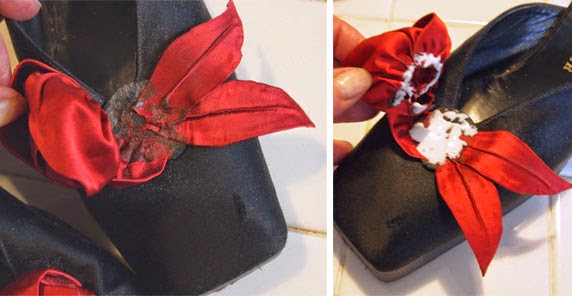
In the meantime I took on the relatively simple job of re-glueing a satin flower on a shoe for my Day 3 project.

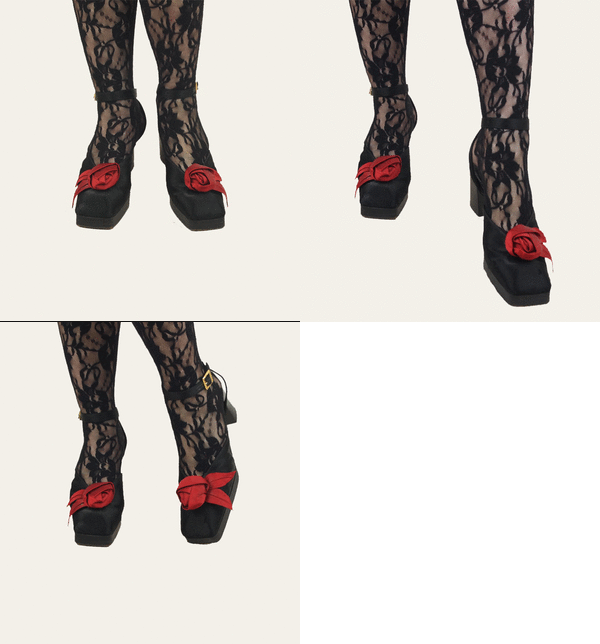
These are not just any shoes but my very favorite shoes, and I’m a shoe addict. Made by Walter Steiger in the 1970s, they have ballet slipper-like squared toes and wrapped ankles. The platforms and heels are just perfect to me, both in style and comfort. I could wear these all day every day if they weren’t so dear to me. I wear them only occasionally with the hope they will last forever.

I have a drawerful of glues and a tendency to read every label before I decide which one to use. I think I will stop reading the fine print in great detail now that I know there is a Design Sponge article which includes types of adhesives, a chart of appropriate glues for various tasks, how to glue properly, and even a natural glue recipe. When it comes to glueing fabric, make sure you use one that is appropriate to the cleaning of the item (dry clean only or washable). In this case, the shoes will not be cleaned other than dusting. I used Soba Premium Craft and Fabric Glue.

Mission accomplished, they are ready to step out again!

Comment

Comment

Make do and mend: Easter edition

It is Day 2 of my challenge to mend or clean 12 of my own wardrobe’s items in 12 days. It is also Easter, so I contemplated which of my mending items would look spiffy to wear on Easter Sunday.

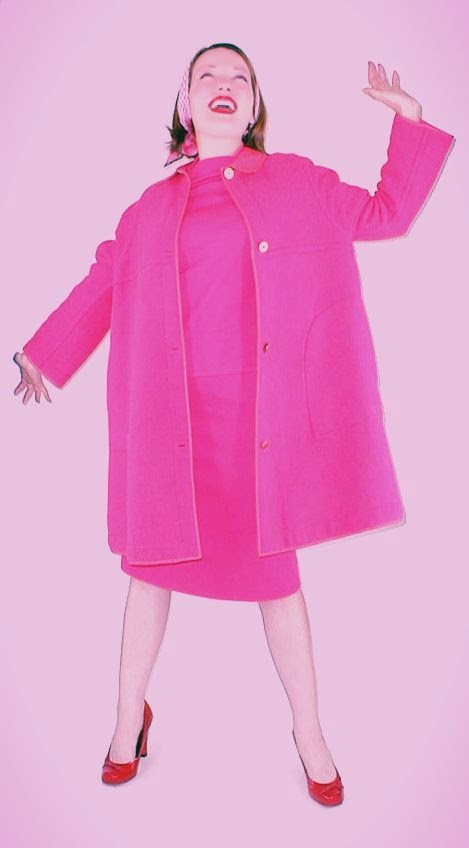
I decided the obvious choice was a wonderful late 1930s jacket that has been out of commission for a few years. It is labeled Haddad. If the clothing I find with this label is any indication, the store was a very fashionable place to shop in Spokane. A number of older women have told me how much they loved the place.

This jacket is made of a light, spring-y black wool crepe with bright pink wool jersey lining the front edges and collar. The jacket even has a matching pink jersey dicky. It has little semi-pockets with twisted wool detail around their edges.

The problem has been the covered buttons. Made using the same light wool jersey, these had worn through to the point of being unusable.

This is where my one hoarding instinct has come in handy: I collect vintage buttons, and most especially sets of vintage buttons. Many button collectors are after a single perfect vintage button, but my eyes are always open for a set that can replace those that are missing on my vintage clothing finds.

In my black button stash I have a couple of great old buttons in plastic and four faceted black glass buttons. I need five for my jacket. I have cards of vintage buttons in black but these just don’t seem sufficiently interesting for this stellar jacket.

I eventually came across this set, probably of roughly the same era as the jacket. I would prefer a button with a shank, but I love the beaded-look detail.

If I’ve learned anything from mending my vintage clothing finds, it is to try to imitate what is already there. These buttons were sewn with substantial thread shanks, and without any of their sewing thread showing on the back of the placket, because that pink lining was made to show and you wouldn’t want black threads interfering.

I used to think that sewing a button was just a matter of running six stitches through the button, but had to rethink my button sewing technique when I saw how many vintage buttons were sewn with thread shanks.

There is an easy and clear tutorial about sewing a button the right way, with a thread shank, over on the Chronicle Books blog.

Just one case of gnarled-up thread and one needle poke later, I had myself a newly restored jacket. See how nicely these buttons complement the pocket detail?

And it’s ready just in time for my Easter promenade. Happy Easter everyone!

Comment

Comment

Make do and mend: The 12-day challenge

In my last post I explained how busy a month it is for me and how hard it is to get to mending and cleaning of my favorite clothing with a schedule that is packed to bursting.

Now there are 12 days left in the month and 12 items are on my agenda to fix. Can I do it? I’m not entirely sure! Stay tuned to find out.

I am starting today with one of my favorite items in need of help, a relatively recent (purchased about four years ago) jacket by Anne Klein. It was radiant orchid before anyone was talking about radiant orchid, and when I wear this jacket people tend to comment on how good the color is on me.

Last fall I was on a weekend trip to Seattle and Ibeing Mistress of the Grand Gesture—ripped out a seam at the back of an armhole. I didn’t have a sewing kit with me so inquired about one at the desk of the motel where we were staying. The best color thread in their little give-away kit was closer to Seattle Sky Grey than Radiant Orchid but I made do and tried to sew up the seam thoroughly and as inconspicuously as possible.

This was meant to be very temporary but of course I didn’t go to replace the stitching until today, a few days after my hand sewing ripped out. This time I did it right, with a sewing machine. I had to unpick the lining for a short stretch at the hem in order to get at the seam properly, but once it was open I could make a sturdy machine-sewn repair.

I happened to have the exact right color of thread from a project in the 1980s (this color is not new!) and I sewed the seam twice, being the Grand Gesture Princess. I briefly thought of reinforcing the other armhole in case I might care to wave my left arm about madly in the future, but decided I’m too much of an optimist.

Then all that remained was to hand sew the short stretch of lining at the hem.

And here it is, my sturdy seam, ready for one of my famous grand gestures:

Comment

1 Comment

Vintage with messages


I have heard from some of you how much you like the background stories of vintage items of clothing. Lots of times I’m asked about the history of a particular dress and can’t say, but personal encounters make the clothes come alive in a great way.

In the past few weeks I have found a couple items with notes. I didn’t meet the original owners but their notes are such lovely links to the past.

This hat, in my Etsy shop, was wrapped with tissue:


This dress came from another woman with a note pinned inside the neckline. It is in my web store now:


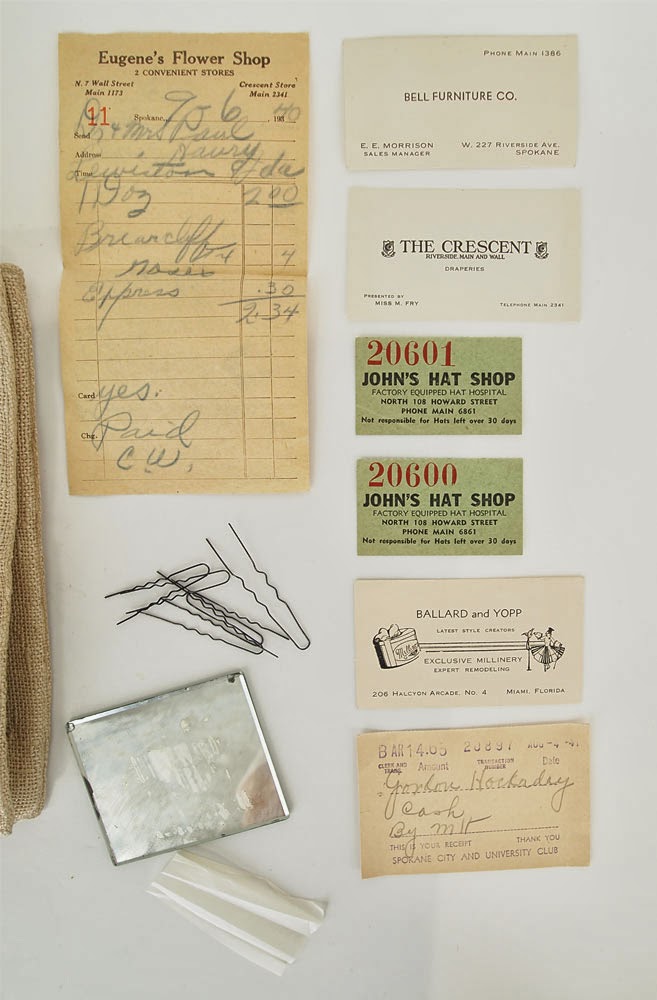
One of the more interesting time capsules I’ve seen in my vintage business is this linen clutch with its contents, from the years 1940 and 41, intact.


1 Comment

4 Comments

My vintage sources


I sometimes get to know something of the women from whom I acquire vintage clothing.

I’ve written about Jacqueline, the mother of a very good friend of mine (I love my vintage clothing sources)


Juana, who worked as a model for one of Spokane’s department stores (Another favorite source)


Helen, a philanthropist (An ode to Helen South Alexander and A tiny fraction of Mrs. Alexander’s clothing)


I woman I only know through her grand niece (The suitcase lot)


Mrs. Gordon, whose husband was blinded in WWII yet she dressed to the nines (You’re a sight to see, Mrs. Gordon!)


Alice, about to be married for the second time at the wonderful age of 85+ (Lovely lady lot)


Betty, who was a manager at one of Spokane’s department stores (She’s a Betty)


There are more, and they have been so gracious to me. I have many unofficial grandparents!

I think of Ruby, who made her own clothes with impeccable skill and cried when I offered her money for the clothing, which she was just going to “put out on the curb.” All 100+ pieces of it!


Mrs. Walls, who had “forgotten she had all these clothes” in her basement


Shirley, who let me come to her garage sale way out in the country a day early because she figured no one would care about the clothes (there were enough to open a store)


There was the gentleman whose wife had passed away and he was finally ready to let go of some of her clothing. He gave me a fantastic set of highballs he bought at the 1963 Seattle World’s Fair when he found out I’d grown up in Seattle.


One man I met had just purchased and laid down a load of stones to make his driveway a little smoother for my visit. His wife had been a manager of better sportswear at a department store in Spokane. We talked quite a bit because my father played jazz trombone and he had a boatload of jazz albums and played jazz himself. He asked me where I thought he got his accent and I guessed New York. He said Chicago, which is his nickname. He came to Spokane when he was 12 and he is now 105. 


Then there was Elaine who was sweeping her walk when I first met her. She is African American and came to Spokane on V-J Day, September 2, 1945. Her clothes were so precisely cared for and pristine that they were as if new.


There are many more. One that truly haunts me was an Italian-American model whose daughter offered me her mother’s clothing. She had wonderful items, including this Howard Greer dress. I happened to see her photo and she was one of the most beautiful women you could possibly imagine. She had died estranged from her family and had a very hard life, including alcoholism. Her clothing was very well kept and of spectacular design.


I like to think that we perpetuate these people through carrying their stories—and their clothing—forward.


4 Comments

Comment

Make some noise!

Happy 2014! I have reason to celebrate: Thank you for the incredible support you showed me in 2013. I will gush on more soon, but for now, let's make some noise:


Comment

2 Comments

Fabric of the week: Gabardine


It is my 50th fabric of the week entry, and I can’t believe I’m just getting around to this one! Gabardine is a revered fabric—I’ve had many an older woman confess to me it is her favorite. I just wish younger people had a chance to know it better.

Gabardine 

Gabardine is characterized by either steep or sometimes regular twill, tightly woven, with fine, distinct diagonal ribs on the surface and a smooth back. Wools are right-hand twill, cotton may be left-hand. The warp generally has twice as many threads per inch as the weft. Made of worsted, cotton, manufactured fibers, blends, and (rarely) silk. 
Because gabardine is tightly woven (particularly in a steep twill weave) the fabric is hard-wearing and rain resistant. Its name derives from the Medieval Spanish word gabardina which means protection from the elements. 

The name was originally used for a cloak worn in the Middle Ages.
Uses: Suits, coats, rainwear, slacks, skirts, uniforms, dresses, sportswear, shirts, hats
See also:
Covert cloth

Worsted wool gabardine

Rayon gabardine
©Vintage Fashion Guild - Text by Margaret Wilds/denisebrain,  photos by Hoyt Carter

2 Comments

Comment

Fabric term of the week: 2/1, 3/1, 2/2 etc.            


Before you think this week’s fabric term is a math problem: These fraction-like numbers are a way of quickly describing how many yarns cross each other in a fabric’s construction.

2/1, 3/1, 2/2 etc. 
Woven fabric consists of warp and weft yarns crossing each other one at a time or in groups. Plain weave always consists of one warp yarn crossing one weft yarn, a 1/1 weave. When two warp yarns cross a weft yarn, this can be indicated as 2/1 weave. 2/2 weave has two warp yarns crossing two weft yarns. 
These fractions are read, for example, “three up, one down” for 3/1, indicating that three weaving harnesses are raised, then one is lowered for three warp yarns on the face, then one weft yarn. 
See also
 Weaving

A satin weave is most commonly 4/1 with warp yarns floating over weft yarns in numbers of 4 to 1, but can be 7/1 and even 11/1, and the interlacings do not occur in rows, giving the most uninterrupted gloss possible.

One of the more jaw-dropping satin dresses I’ve had a chance to see up close is this Ceil Chapman ball gown currently in my web store. The fabric really defines “pour of satin.”


Comment

Comment

Fabric term of the week: Nylon


The very first synthetic fiber? It was a revolutionary creation at its invention.

Nylon
The invention of nylon is credited to the chemist Wallace Carothers, working at DuPont in the 1930s. It was the first successful synthetic fiber, rayon and acetate being plant-based manufactured fibers. This first nylon was polyamide 6,6—made from hexamethylenediamine and adipic acid (the 6,6 designates the two stretches of six carbon atoms that are repeated in the polymer chain). The fiber proved strong, elastic, quick to dry, and insect- and rot-resistant. The first application was in toothbrushes in 1938, but in the next year women’s hosiery became nylon’s first big success. One might even have called it a raging success, the clamor for nylons (as they came to be called) was so great. 
During WWII the new fiber was used in the war effort, taking the place of Japanese silk for parachutes. After the war, the clamor for nylons took up where it left off, and soon nylon was used for other garments—and in many household products—as it is to this day.
Publicity photo for nylon, New York World’s Fair, 1939
1960s nylon tricot knit flapper-look nightgown in my Etsy shop


If you haven’t seen already, I made a handy-dandy (if I do say so) timeline of manufactured fabrics in the VFG Fabric Resource, and here on my blog.

Comment