1 Comment

Vintage with messages


I have heard from some of you how much you like the background stories of vintage items of clothing. Lots of times I’m asked about the history of a particular dress and can’t say, but personal encounters make the clothes come alive in a great way.

In the past few weeks I have found a couple items with notes. I didn’t meet the original owners but their notes are such lovely links to the past.

This hat, in my Etsy shop, was wrapped with tissue:


This dress came from another woman with a note pinned inside the neckline. It is in my web store now:


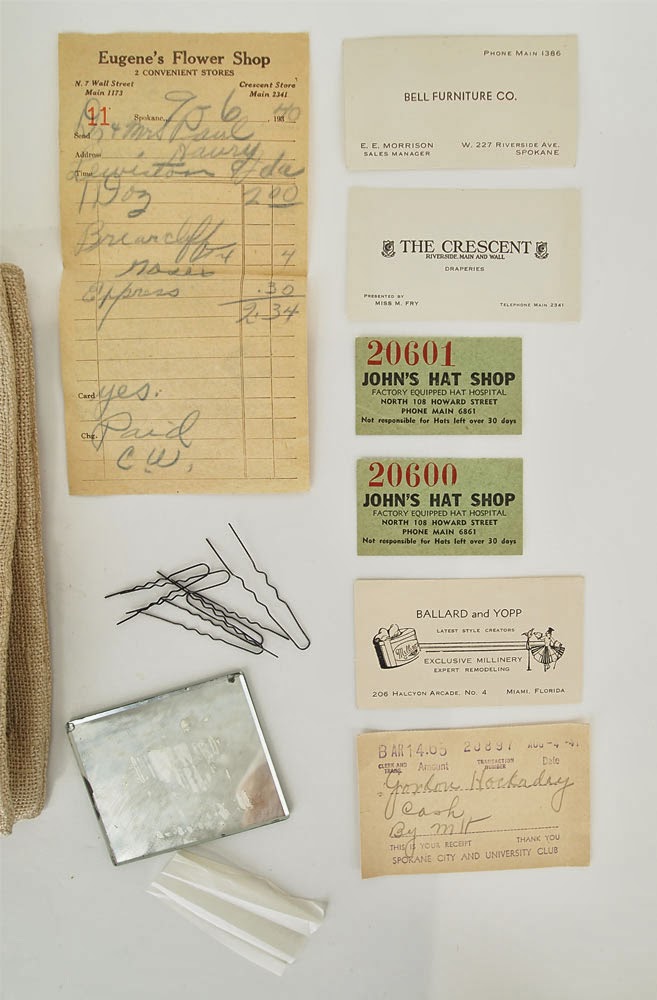
One of the more interesting time capsules I’ve seen in my vintage business is this linen clutch with its contents, from the years 1940 and 41, intact.


1 Comment

4 Comments

My vintage sources


I sometimes get to know something of the women from whom I acquire vintage clothing.

I’ve written about Jacqueline, the mother of a very good friend of mine (I love my vintage clothing sources)


Juana, who worked as a model for one of Spokane’s department stores (Another favorite source)


Helen, a philanthropist (An ode to Helen South Alexander and A tiny fraction of Mrs. Alexander’s clothing)


I woman I only know through her grand niece (The suitcase lot)


Mrs. Gordon, whose husband was blinded in WWII yet she dressed to the nines (You’re a sight to see, Mrs. Gordon!)


Alice, about to be married for the second time at the wonderful age of 85+ (Lovely lady lot)


Betty, who was a manager at one of Spokane’s department stores (She’s a Betty)


There are more, and they have been so gracious to me. I have many unofficial grandparents!

I think of Ruby, who made her own clothes with impeccable skill and cried when I offered her money for the clothing, which she was just going to “put out on the curb.” All 100+ pieces of it!


Mrs. Walls, who had “forgotten she had all these clothes” in her basement


Shirley, who let me come to her garage sale way out in the country a day early because she figured no one would care about the clothes (there were enough to open a store)


There was the gentleman whose wife had passed away and he was finally ready to let go of some of her clothing. He gave me a fantastic set of highballs he bought at the 1963 Seattle World’s Fair when he found out I’d grown up in Seattle.


One man I met had just purchased and laid down a load of stones to make his driveway a little smoother for my visit. His wife had been a manager of better sportswear at a department store in Spokane. We talked quite a bit because my father played jazz trombone and he had a boatload of jazz albums and played jazz himself. He asked me where I thought he got his accent and I guessed New York. He said Chicago, which is his nickname. He came to Spokane when he was 12 and he is now 105. 


Then there was Elaine who was sweeping her walk when I first met her. She is African American and came to Spokane on V-J Day, September 2, 1945. Her clothes were so precisely cared for and pristine that they were as if new.


There are many more. One that truly haunts me was an Italian-American model whose daughter offered me her mother’s clothing. She had wonderful items, including this Howard Greer dress. I happened to see her photo and she was one of the most beautiful women you could possibly imagine. She had died estranged from her family and had a very hard life, including alcoholism. Her clothing was very well kept and of spectacular design.


I like to think that we perpetuate these people through carrying their stories—and their clothing—forward.


4 Comments

Comment

Make some noise!

Happy 2014! I have reason to celebrate: Thank you for the incredible support you showed me in 2013. I will gush on more soon, but for now, let's make some noise:


Comment

Comment

Not a creature was stirring

Happy December and happy all it means to each of us! My latest theme...


Comment

2 Comments

Fabric of the week: Gabardine


It is my 50th fabric of the week entry, and I can’t believe I’m just getting around to this one! Gabardine is a revered fabric—I’ve had many an older woman confess to me it is her favorite. I just wish younger people had a chance to know it better.

Gabardine 

Gabardine is characterized by either steep or sometimes regular twill, tightly woven, with fine, distinct diagonal ribs on the surface and a smooth back. Wools are right-hand twill, cotton may be left-hand. The warp generally has twice as many threads per inch as the weft. Made of worsted, cotton, manufactured fibers, blends, and (rarely) silk. 
Because gabardine is tightly woven (particularly in a steep twill weave) the fabric is hard-wearing and rain resistant. Its name derives from the Medieval Spanish word gabardina which means protection from the elements. 

The name was originally used for a cloak worn in the Middle Ages.
Uses: Suits, coats, rainwear, slacks, skirts, uniforms, dresses, sportswear, shirts, hats
See also:
Covert cloth

Worsted wool gabardine

Rayon gabardine
©Vintage Fashion Guild - Text by Margaret Wilds/denisebrain,  photos by Hoyt Carter

2 Comments

Comment

Fabric term of the week: 2/1, 3/1, 2/2 etc.            


Before you think this week’s fabric term is a math problem: These fraction-like numbers are a way of quickly describing how many yarns cross each other in a fabric’s construction.

2/1, 3/1, 2/2 etc. 
Woven fabric consists of warp and weft yarns crossing each other one at a time or in groups. Plain weave always consists of one warp yarn crossing one weft yarn, a 1/1 weave. When two warp yarns cross a weft yarn, this can be indicated as 2/1 weave. 2/2 weave has two warp yarns crossing two weft yarns. 
These fractions are read, for example, “three up, one down” for 3/1, indicating that three weaving harnesses are raised, then one is lowered for three warp yarns on the face, then one weft yarn. 
See also
 Weaving

A satin weave is most commonly 4/1 with warp yarns floating over weft yarns in numbers of 4 to 1, but can be 7/1 and even 11/1, and the interlacings do not occur in rows, giving the most uninterrupted gloss possible.

One of the more jaw-dropping satin dresses I’ve had a chance to see up close is this Ceil Chapman ball gown currently in my web store. The fabric really defines “pour of satin.”


Comment

1 Comment

Favorite vintage: The goddess dress

Kathryn’s favorite vintage dress met an untimely end, but she may yet find another like it—Now that I know this story, I will keep both eyes open for another.  

My favourite vintage item sadly does not exist any more but I’ve never forgotten it. I bought it from a secondhand shop in the High Street of Oxford (in the United Kingdom) where I was at university in the 1980s. Back then, selling and wearing vintage was not as commonplace as it is now, but this shop stocked a small selection.

The dress that caught my eye was what some people now call a “Goddess” dress. It was navy blue and finely vertically pleated throughout with a boat neckline and a matching cinch buckled belt. The dress was straight, knee length, sleeveless (I think there was some gathering detail at the shoulder) and was labelled as being from 1964. It had a touch of the Audrey Hepburn about it, although she is the last person I resemble, but I tried it on and it looked like it had been made for me, so I bought it on my meagre student income. I think it was the first vintage item I ever bought.

With its simple lines, it was timeless (it would look equally as good today), chic, slimming and in total contrast with the fussy, ruffled, brightly-coloured fashions of the day. I wore it a lot and always got compliments in it. It worked for day or evening. It didn’t need jewellery as the statement neckline and the pleats spoke for themselves.

It went with me on dates and parties I’ve long forgotten but I’ve never forgotten that dress.

Sadly, it met an untimely end.

I came back from university and and my mother took it upon herself, without telling me, to wash the dress in the washing machine. I don’t know what happened but all the pleats fell out, leaving the dress just a large navy blue tent—it was ruined, unwearable.

This is the only picture I’ve got of me in the dress—it was taken in a grassy field in the country in Somerset (told you I wore it everywhere!) when I was on break with a friend just before my final exams at university. It doesn’t really show all the fine details of the dress but you can see its clean and simple lines.

I’d love another dress like that but have sadly never seen one.

Funnily enough Margaret of Denisebrain had a very similar dress up for sale on her Etsy site a year or two back, in the very same colour, but by the time I saw the link, it had already been sold...

I know just the one she means, and now I’m so sorry it didn’t sell to you Kathryn—The next one is yours, I promise!

1 Comment

Comment

Fabric term of the week: Nylon


The very first synthetic fiber? It was a revolutionary creation at its invention.

Nylon
The invention of nylon is credited to the chemist Wallace Carothers, working at DuPont in the 1930s. It was the first successful synthetic fiber, rayon and acetate being plant-based manufactured fibers. This first nylon was polyamide 6,6—made from hexamethylenediamine and adipic acid (the 6,6 designates the two stretches of six carbon atoms that are repeated in the polymer chain). The fiber proved strong, elastic, quick to dry, and insect- and rot-resistant. The first application was in toothbrushes in 1938, but in the next year women’s hosiery became nylon’s first big success. One might even have called it a raging success, the clamor for nylons (as they came to be called) was so great. 
During WWII the new fiber was used in the war effort, taking the place of Japanese silk for parachutes. After the war, the clamor for nylons took up where it left off, and soon nylon was used for other garments—and in many household products—as it is to this day.
Publicity photo for nylon, New York World’s Fair, 1939
1960s nylon tricot knit flapper-look nightgown in my Etsy shop


If you haven’t seen already, I made a handy-dandy (if I do say so) timeline of manufactured fabrics in the VFG Fabric Resource, and here on my blog.

Comment

1 Comment

Favorite vintage: My odd collection

This is a rerun post, originally published in 2006 (wow...seven whole years ago!). I have a couple of other small vintage clothing collections, but this is probably the one that would surprise most.

The first time I laid eyes on a crazily-bright half slip my heart did a somersault!

I think I love these because they came at a time when fashion was evolving. Particularly the late 60s ones seem to struggle to be relevant at a time when the previously mandatory slip was about to become uncool and outmoded. They are also fun, funny and undisclosed...a secret party!

I never go looking for these half slips, they just sort of fall in my path, like lucky pennies.

I have four more of these fun half slips now...and as always, they just fell my way.

Do you have a favorite vintage collection? A surprising vintage collection?

1 Comment

Comment

Fabric of the week: Wool flannel

I can sympathize with people who say they can’t wear wool. I feel I am sensitive to it, but realized early on that there is a wide range of wool grades and fabric constructions, to which my skin has a wide range of reactions. Worsted flannel is a wool that I feel immune to, soft and smooth as it is. It is a sheep in sheep’s clothing!
Flannel, wool 
A warm fabric with a soft, close nap, flannel may be in a plain or twill weave. It is brushed to create the nap, and this may be on one or both sides. If woolen, it can be in a plain or twill weave, while worsted flannels are right-hand twills, finer and appreciably more substantial.

Flannel was originally always wool (the name is derived from the Welsh word for flannel, gwlânen, which is derived from gwlân, “wool”). It is now found in wool blends, often with cotton.

Uses: Jackets, suits (men’s particularly of worsted flannel), dresses, shirts, skirts

See also:
Flannel, cotton
Wool flannel
Worsted flannel
©Vintage Fashion Guild - Text by Margaret Wilds/denisebrain,  photos by Hoyt Carter
1950s worsted flannel skirt by Evan-Picone in my Etsy shop


Comment

Comment

Fabric of the week: Duvetyn, blanket cloth


Thinking about a winter coat yet? I know just the fabric for a soft and warm coat; and it’s much more likely to be a vintage coat because such finely-finished wools are not so common now. 

Duvetyn, blanket cloth

The name duvetyn comes from the French word duvet, meaning down. Wool or wool-blend commonly, the finish is napped, sheared and fulled. This creates a downy nap which covers its weave which is usually right-hand twill. It is softer and more lustrous, though its nap isn’t quite as long as that of fleece. 
Cotton duvetyn is usually called suede cloth. 
Uses: Coats, uniforms, suits; the heavier blanket cloth for blankets and Hudson’s Bay “point” blanket coats 
See also:
 Doeskin, 
Fleece
Wool duvetyn
©Vintage Fashion Guild - Text by Margaret Wilds/denisebrain,  photo by Hoyt Carter

This cashmere duvetyn coat is new to my Etsy shop. I wish you could feel the softness of this elegant fabric!


Comment

Comment

Fabric of the week: Simplex


If you have noticed the soft feel and firm stretch of a pair of gloves, you have most likely noticed simplex, a fabric used most commonly for vintage gloves. 
Simplex 

Made on a tricot machine, simplex is a firm knit that shows plain stitch knits on both sides, instead of tricot’s zigzag reverse. 
Uses: For gloves, cotton simplex is used after shrinking and sueding. It is heavier than tricot, generally, and appropriate for bottom weight and more tailored items of clothing. 
See also:
Tricot
Simplex, showing both face and reverse of fabric at edge of glove
©Vintage Fashion Guild - Text by Margaret Wilds/denisebrain, photo by Hoyt Carter


Beaded simplex gloves in my Etsy shop


Comment

Comment

Fabric of the week: Cotton velvet


Here is something that once puzzled me: What is the difference between cotton velvet and velveteen?

Velveteen 

Made of cotton, velveteen has a smooth, soft, short-cut pile on a plain or twill weave ground. Velveteen is related to cotton velvet, but of weft pile weave rather than velvet’s warp pile weave. It is related to corduroy but without that fabric’s vertical rows of wales. Velveteen’s dense pile is slightly flatter and shorter than that of cotton velvet. 
Uses: Dressy but less expensive (than velvet) in women’s and children’s clothing

Cotton velvet
Velveteen
©Vintage Fashion Guild - Text by Margaret Wilds/denisebrain,  photos by Hoyt Carter

Do you see the vertical lines in the cotton velvet? And the horizontal lines in the velveteen?

That’s how I was able to determine that this coat in my web store is made of cotton velvet.


To be truthful, I am not sure if I would be able to discern some fabrics with any accuracy if it weren’t for this tool, a linen tester. Highly recommended if you want to know the thread count of a fabric, as well as magnify it. Obviously a magnifying glass would do just fine for close-up viewing:


Comment

2 Comments

Fabric term of the week: Shadow stripes


This fabric term of the week allows me to highlight one aspect of the VFG Fabric Resource, the contributions by Claire Schaeffer. If you don’t know of Claire’s work, here is the brief Amazon biography:
Claire Shaeffer is a respected author, lecturer, college instructor and columnist. She frequently contributes articles to sewing magazines, and has authored many books, including Sew Any Patch Pocket, Couture Sewing Techniques, Sew Any Fabric and The Complete Book of Sewing Shortcuts. Claire Shaeffer makes her home in Palm Springs, California.

Her books are enjoyable reads, interesting, highly informative and skillfully researched. Claire is an expert on couture sewing techniques. To put it a little less dryly, she’s all over the place behind the seams!

A few of Claire Schaeffer’s most recent books

I am acquainted with Claire Schaeffer through the Vintage Fashion Guild, of which she is a member, and when she offered a number of definitions from her Fabric Sewing Guide for use in the VFG Fabric Resource I certainly jumped at the chance. It was difficult taking all the best-known fabric resource materials and summarizing without copying. I felt like I was trying to reinvent the wheel. Claire’s succinct definitions, of which I used about 40, were (and are) a huge asset.


Shadow stripes 

Subtle stripes created by weaving the stripes with the same-color yarn with a different twist, weave or with blended yarns slightly lighter or darker. 
From Fabric Sewing Guide by Claire Schaeffer. Krause Publications, Cincinnati, 2008. Used by permission.
©Vintage Fashion Guild - photo by Hoyt Carter


 New in my webstore is a 1950s shirtwaist dress by Anne Fogarty, the fabric made of cotton with shadow stripes, as well as printing.


 The front of the bodice is cut on the bias, so the shadow stripes make a flattering V. Tiny tucks on the vertical add to the visual interest. (Attention to detail—just one of the many reasons to love vintage clothing!)


2 Comments

Comment

Fabric of the week: Burn-out fabric


Are you burned out on fabric? No I’m not either. On the other hand, here is a fabric that is burned out.

Burn-out fabric 

Burn-out (burned-out, burnt-out) fabric is woven of more than one fiber type, then printed with a chemical that will destroy the surface fiber, leaving the ground intact. The result is a fabric patterned with a distinct surface and ground. The ground is usually sheer. 
Velvet is probably the most common type of burn-out fabric. Dévoré (literally “devoured”) velvet is synonymous. 
Uses: Evening wear, bridal, scarves 
See also:

Burn-out velvet
, Dévoré velvet
, Façonné velvet
, Velvet

Burn-out fabric (1930s)
Burn-out velvet (1930s)
©Vintage Fashion Guild - Text by Margaret Wilds/denisebrain,  photos by Hoyt Carter

I’ve just listed this 1920s burn-out velvet dress in my Etsy shop:


Comment

Comment

Fabric term of the week: Flocked fabric


Flock is a word you know as a number of birds together, or congregants at a church, or sheep, or tourists. I don’t blame you if you don’t know the fabric definition...it is often missing from regular dictionaries.

Flocked fabric 

Flock is the name given to very short fibers, either from fabric-making waste or created from rags. A flocked fabric is one on which flocking has been applied with an adhesive, either all over or in a pattern. A common flocked print is dotted swiss. Any fabric weight can be used. 
Flocked fabrics have improved, but the all-over flocked (velvet-like) fabrics can be fairly stiff. Flocking also has the tendency to wear off. 
Uses: Dresses, household decoration, aprons 
See also:
Dotted swiss

Flocked organdy
Flocked voile
©Vintage Fashion Guild - Text by Margaret Wilds/denisebrain,  photos by Hoyt Carter

Currently in my Etsy shop: 50s iridescent taffeta dress and bolero with flocked paisley pattern

Comment

Comment

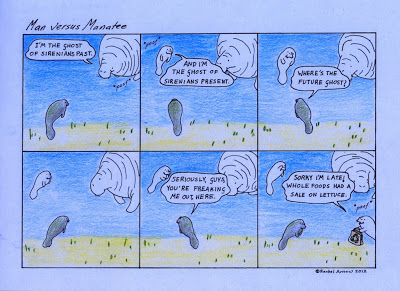
Last day for the manatees


Did that title worry you?

I am always worried about manatees—I wouldn’t want to live on a planet without them. 

My goal is to complete raising the funds for a manatee tracking monitor by the end of tomorrow. If you haven’t already contributed at my YouCaring.com page, or purchased from my shops (1/3 of your purchase going to this cause) this is the time. We are 90% of the way there with 24 hours to go.

Man versus Manatee (http://mvsm.omnomzom.com), used by permission

Comment

Comment

Fabric of the week: Crepon


One of the fabrics with a look reminiscent of tree bark...elegant tree bark that is. 

Crepon 
Crepon and its close cousin bark crepe are characterized by lengthwise wrinkles. Bark crepe resembles the bark of a tree and is usually cotton, linen or rayon. Crepon, too, has a sturdy, vertically-rippled textured and may be silk, manufactured fiber, wool or cotton. The fabrics are compound fabrics, woven on dobby or jacquard looms.
Uses: Dresses, blouses, suits, interior decorating 
See also:
Matelasse


I am fortunate to have this 1960s Helga dress in my Etsy shop right now...I don’t see crepon often. This one was made on a jacquard loom (look at the complexity in the closeup).


©Vintage Fashion Guild - Text and photos by Margaret Wilds/denisebrain


Comment