
Viewing entries tagged
make do and mend

1942 Singer Make-Over Guide

4 Comments

1942 Singer Make-Over Guide

“Make happy use of every last thread of the things you possess.”

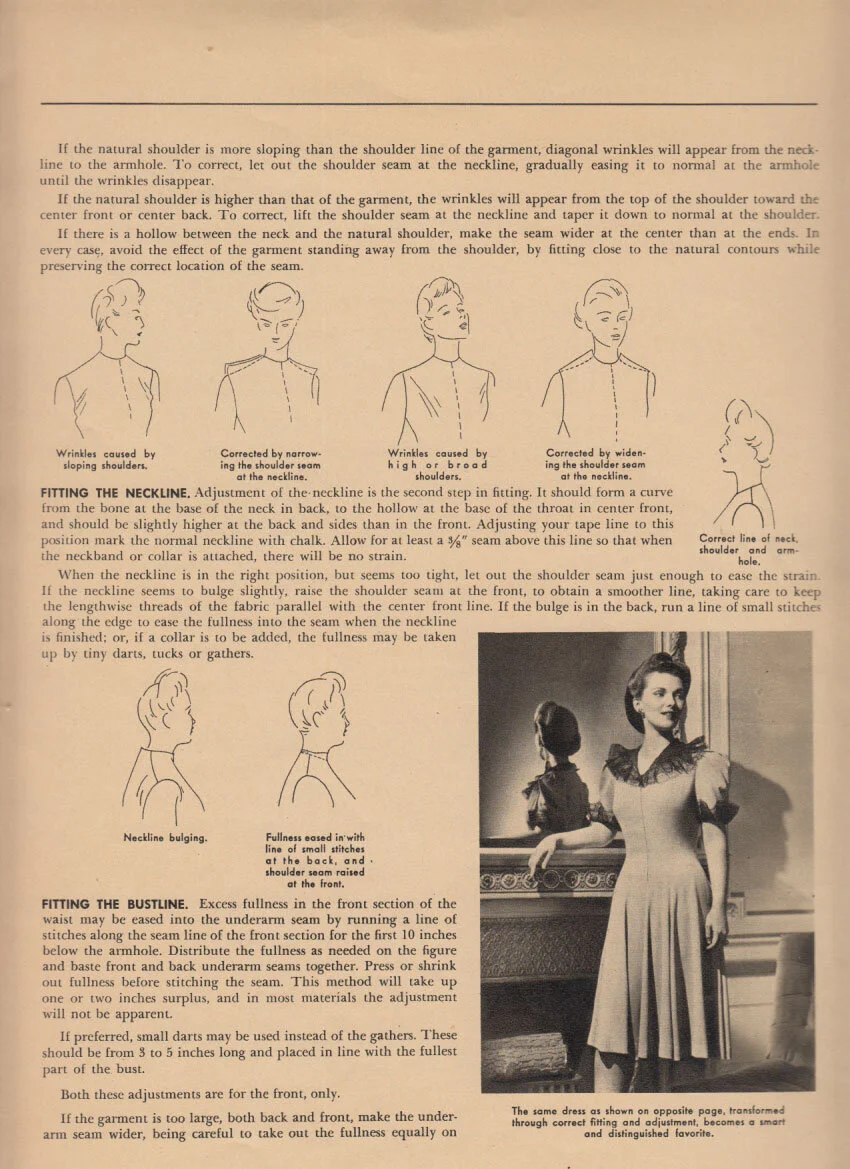
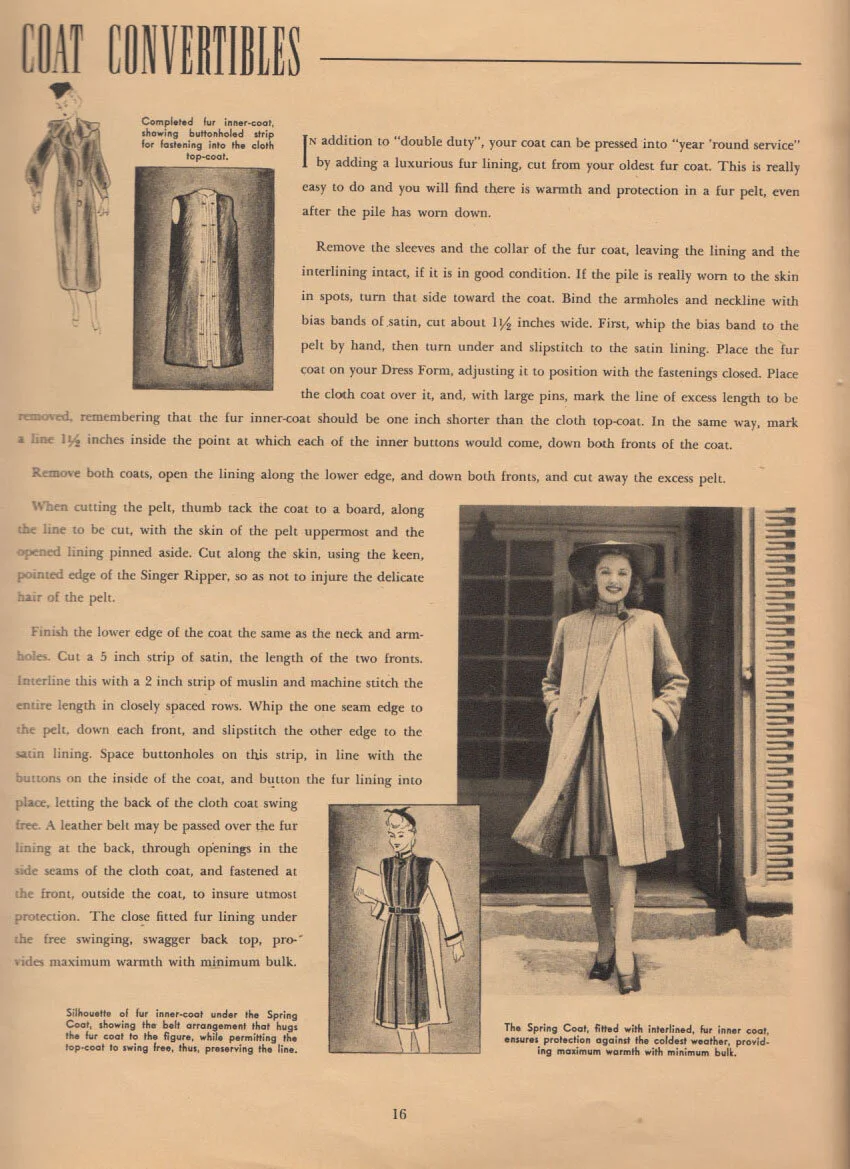
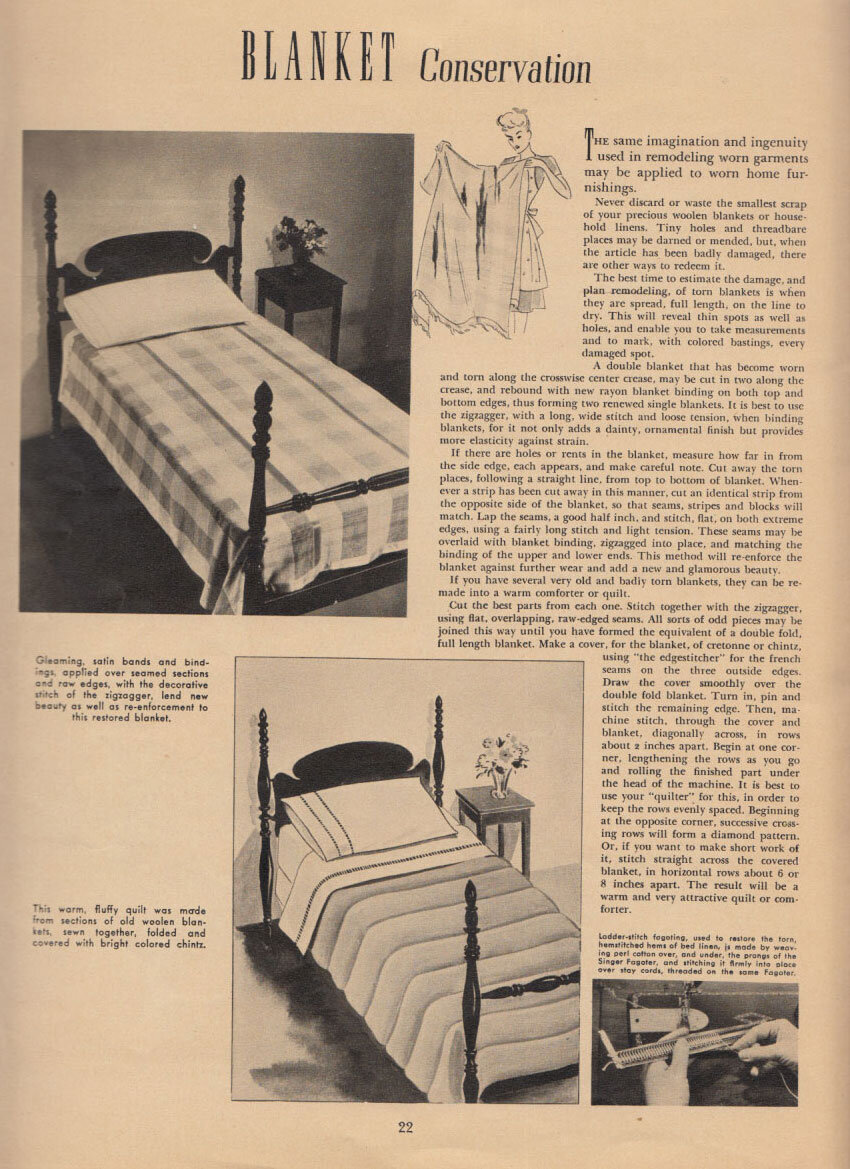
Recently I was given a booklet, published by Singer at the height of World War II. In it are instructions for darning, patching, mending, and altering—but what I find most interesting are the creative ideas for repurposing worn or outmoded items.

My mother in the early 40s

My mother in the early 40s

I grew up with parents who lived through the Great Depression and WWII. My mother, a 22-year-old in 1942, was particularly creative in mending and fixing, reusing, and every frugal skill she’d learned as a young person. She could have written this booklet.

There were many times in my youth when I really wished my mother was not so creative, like when I wanted to have new store-bought clothes but she insisted on making all my clothes. Guess what though? I owe a lot to my mother’s frugality and creativity. I would never have raided my parents’ closets for vintage clothes to wear, and found ways to style them, if I’d had all the latest stuff from the mall. I learned to sew, crochet, applique, tie-dye… I made homemade pants look a bit cooler by sewing patches all over them, I painted plain used t-shirts with band logos. I made a dress out of flowered sheets (got in trouble for that one—the sheets weren’t worn out!).


Back to the booklet. I don’t believe this publication uses the word frugal. Instead, it uses the words ingenious, imaginative, and happy. Above all, it emphasizes the patriotism in using what you already have.


I love the creative projects being called Victory Styles. In 1942, we had our goals set almost impossibly high.

Here is the booklet in its entirety. I especially love the restoring of sweaters on page 4, the rescuing of a shrunken dress on page 10, combining two dresses, pages 12-13, making a woman’s suit out of a man’s suit, page 18, and all the buttons, bags, hats and “lapel gadgets” on the last several pages.


Have you tried reworking or repurposing something worn out? Any creative suggestions for Victory Styles in 2019?

4 Comments

3 Comments

Make do and mend: 50s skirt tear

Still gloating over my success with stains reported yesterday, I decided to tackle a favorite skirt of mine.

This is one of the few items that I was set to sell, then saw the photos I’d taken and just had to keep. This skirt, dating from the 1950s, is black acetate taffeta with a beautiful flocked pattern. There is an attached black tulle crinoline and the waistband is comfortable elastic with a black velvet surface.

Because of that waistband the skirt is uncommonly easy to wear...and vulnerable. The vulnerability is that when the elastic is stretched, the fabric to which it is stitched can tear. One fairly big tear had been mended by a previous owner.

I often like to imitate how an item was made when repairing, or even follow the lead of a previous mender. In this case I find the mend a tiny bit franken-skirt and I’m not particularly thrilled with the taffeta being sewn to the tulle on the inside. You can see the top of this mend has given out.

This is the newer rip that has developed for the same reason.

I am no expert on this type of repair, but I think it could use a little backing for security. I ironed on dark fusible interfacing with the help of a press cloth, then pick-stitched around the tear. Finally I hand sewed across the opening with moderately small stitches. 

I feel it is nicely secure and reasonably inconspicuous (many thanks to that flocked pattern). Would you have done this differently? It would be great to know the best mend in case I spring another leak. 

 I’m not sure how long this will last but I hope forever, because I love the skirt!

3 Comments

6 Comments

Make do and mend: 3-for-1

I have been running a chemistry experiment of sorts for a week.

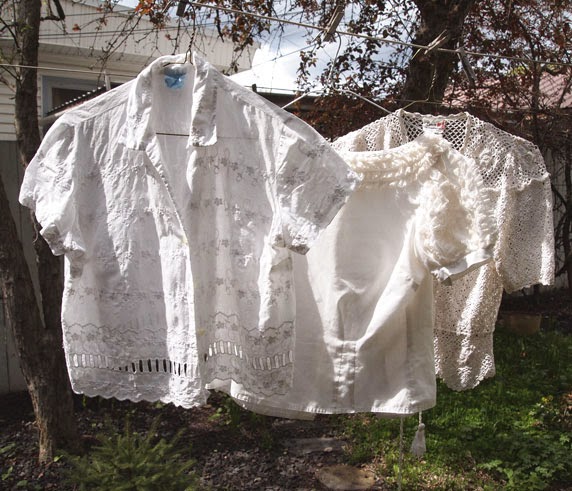
I have three very favorite vintage white blouses (two made of cotton and one poly/cotton blend) dating from the 1940s and 50s. All three of these I wore quite often more than six years ago. Their lengthy careers ended abruptly when somehow they got into a warm wash load with bleach.

Have you seen what happens to very subtle underarms stains when they are bleached? Those subtle underarm stains turn an angry shade of yellow that refuses to be removed.

Yes, denisebrain sweats. There I said it.

However I love these three blouses so much that I kept them on the off chance I would find a new solution to their problem.

Because of my resolve to help my fix-me pile this month, I decided to give many solutions a try on these blouses. I like to start from the least toxic alternative and work my way into the nasty stuff.

First it was baking soda paste (with water). If you have unbleached fairly recent underarms stains this can work, but for me this time...nada.

Then it was a slightly diluted white vinegar soak. The blouses smelled like tossed salad and the stains didn’t budge at all.

Next I got out other non-bleach stain removers. Ammonia has been recommended to me by dry cleaners for washable sweat-stained clothing. I gave the ammonia several chances. Then I used Pit Stop, among other things.

PitStop (now called Raise) is, for many cases of recent sweat stains, very effective on washable clothing. However, I’m truly disturbed that the ingredients are not listed on the bottle. Thanks to an about.com page by Mary Marlowe Leverette, I know that the active ingredients are:

- sodium hydroxide, also known as lye or caustic soda

- cocamidopropyl betine, a synthetic surfactant derived from coconut oil and dimethylaminopropylamine

- EDTA or Ethylenediaminetetraacetic acid, a polyamino carboxylic acid

Rubber gloves, open doors, a breathing mask and multiple attempts later...nothing. It didn’t even begin to budge these old bleach-set stains.

Finally in desperation I searched online using terms like “stubborn,” “old,” “bleach-set,” “impossible,” “horrendous”... OK, so I exaggerate slightly. I found The Art of Manliness blog on the subject. With the writer’s six year-old yellowed stains he had no success with ammonia but he had great success with a less toxic solution: OxiClean.

So into the OxiClean went my blouses. In two full days I saw maybe some letting up. In the meantime, I could at least breathe around the soaking solution, so I let the blouses stay in the solution for five days. After five days...100% success! The blouses are cleaner than the’ve ever been and those bleach-set sweat stains finally packed up and went home.

I could practically cry for joy to get these favorite blouses back! It is true that the more epic the effort the better it feels to achieve the goal. I feel pretty good!

Do you have any fabulous stain removal tricks?

Come on, I just told you one of mine! 

6 Comments

Comment

Make do and mend: Earth Day edition


It is day four of my 12-day mend/fix/clean challenge. Today I’m very glad to keep an item going, because on Earth Day I am especially interested in making do with what I have.

I found an early 1970s suit in a thrift store in 1999, the year I began my vintage clothing business. I saw that it had no buttons on its jacket but I immediately loved it, took it home, found some white buttons to sew on and have worn it all the time since.


Yes it’s double knit polyester, yes it’s loud. On Earth Day about six years ago a music colleague of mine asked me if I would like to join in the local Procession of the Species wearing the outfit. Apparently I looked to him a bit like a wild critter of some sort. I took that as a big compliment.

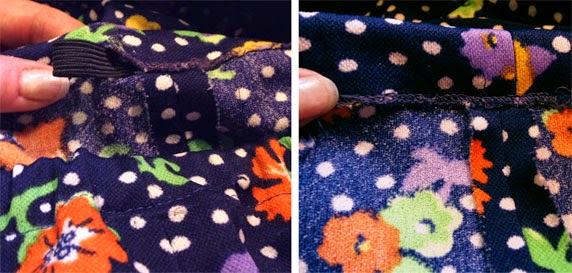
This outfit was originally sewn with that nasty clear plastic thread that was used in the 1970s. I can’t tell you how many times I have pulled a little bit of that thread only to have the entire hem fall out of a skirt...this one included. I long ago re-sewed the hem. Now the casing at the waistband has come partly unstitched and the elastic is shot.


The elastic has stood up pretty well considering it dates from about 1973, but... 

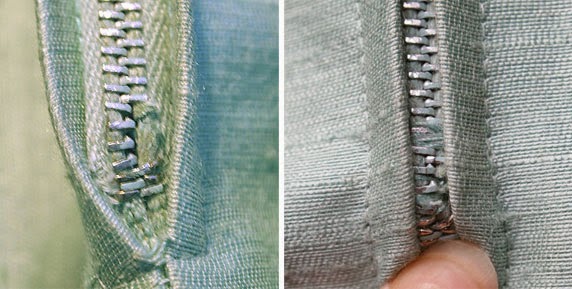
I don’t have a fancy sewing machine. It has two stitches: Forward and backward. Still, I adore my sewing machine, a vintage Singer Featherweight that belonged to my mother. I restitched the casing and pulled elastic through (my waist size + about 1" in length), sewed the elastic ends together and sealed up the opening. 


Now I have my crazy wonderful suit back in time for Earth Day:


I’ll bet most of you know how to do this, or could easily do this when needed, and it is a very handy skill for vintage clothing appreciators. There are a number of simple tutorials for the technique online, such as this one.

Save your vintage clothing ...and Happy Earth Day!

Comment

Comment

Make do and mend: Day 3

Right now I have several chemistry experiments going on with stains in my favorite clothing...I will report back when I found out which, if any, are successful.

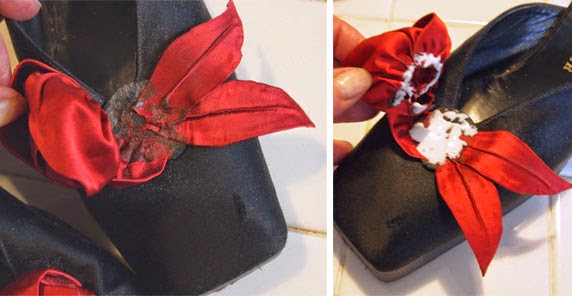
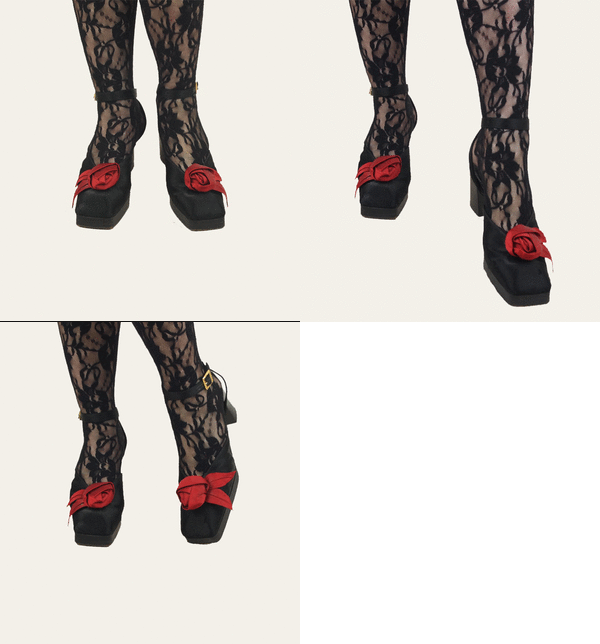
In the meantime I took on the relatively simple job of re-glueing a satin flower on a shoe for my Day 3 project.

These are not just any shoes but my very favorite shoes, and I’m a shoe addict. Made by Walter Steiger in the 1970s, they have ballet slipper-like squared toes and wrapped ankles. The platforms and heels are just perfect to me, both in style and comfort. I could wear these all day every day if they weren’t so dear to me. I wear them only occasionally with the hope they will last forever.

I have a drawerful of glues and a tendency to read every label before I decide which one to use. I think I will stop reading the fine print in great detail now that I know there is a Design Sponge article which includes types of adhesives, a chart of appropriate glues for various tasks, how to glue properly, and even a natural glue recipe. When it comes to glueing fabric, make sure you use one that is appropriate to the cleaning of the item (dry clean only or washable). In this case, the shoes will not be cleaned other than dusting. I used Soba Premium Craft and Fabric Glue.

Mission accomplished, they are ready to step out again!

Comment

Comment

Make do and mend: The 12-day challenge

In my last post I explained how busy a month it is for me and how hard it is to get to mending and cleaning of my favorite clothing with a schedule that is packed to bursting.

Now there are 12 days left in the month and 12 items are on my agenda to fix. Can I do it? I’m not entirely sure! Stay tuned to find out.

I am starting today with one of my favorite items in need of help, a relatively recent (purchased about four years ago) jacket by Anne Klein. It was radiant orchid before anyone was talking about radiant orchid, and when I wear this jacket people tend to comment on how good the color is on me.

Last fall I was on a weekend trip to Seattle and Ibeing Mistress of the Grand Gesture—ripped out a seam at the back of an armhole. I didn’t have a sewing kit with me so inquired about one at the desk of the motel where we were staying. The best color thread in their little give-away kit was closer to Seattle Sky Grey than Radiant Orchid but I made do and tried to sew up the seam thoroughly and as inconspicuously as possible.

This was meant to be very temporary but of course I didn’t go to replace the stitching until today, a few days after my hand sewing ripped out. This time I did it right, with a sewing machine. I had to unpick the lining for a short stretch at the hem in order to get at the seam properly, but once it was open I could make a sturdy machine-sewn repair.

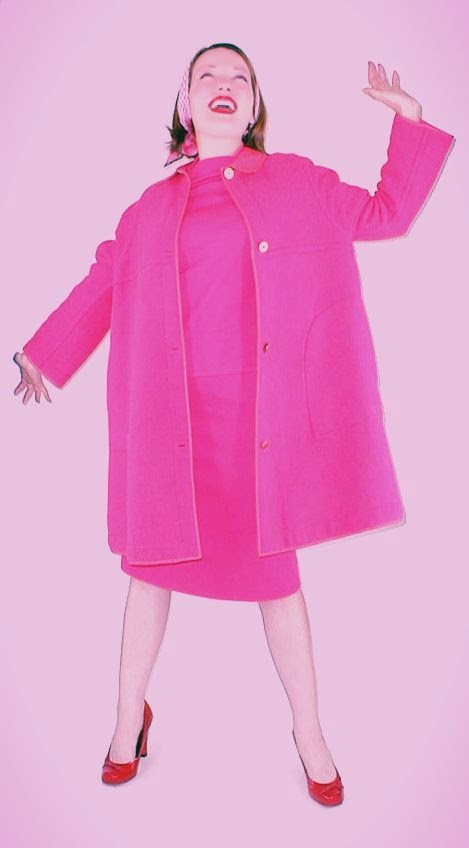
I happened to have the exact right color of thread from a project in the 1980s (this color is not new!) and I sewed the seam twice, being the Grand Gesture Princess. I briefly thought of reinforcing the other armhole in case I might care to wave my left arm about madly in the future, but decided I’m too much of an optimist.

Then all that remained was to hand sew the short stretch of lining at the hem.

And here it is, my sturdy seam, ready for one of my famous grand gestures:

Comment